

Expert GuestsFounders
What I Learned From Interviewing Founders Who Sold for $100M+
After 300 founder interviews, certain patterns only show up above a certain exit size. Here are the ones that surprised me most.
A podcast can be marketing overhead or pipeline infrastructure. Here's how 320 founder interviews became relationships, advice, and launch leverage - not just content.
 Sean Weisbrot- Founder, SparkVox

Most founders treat a podcast as marketing overhead. Record, publish, promote, repeat. That framing misses the commercial value entirely. For me, the podcast became go-to-market: a system for building relationships with the exact people I would eventually need as customers, advisors, and amplifiers.
After 320 founder interviews, the pattern is clear. The show was not content. It was pipeline infrastructure disguised as content.
Cold outreach to an eight-figure founder fails for predictable reasons. They get dozens of pitches a week. Your product is unknown. The ask is one-sided. An interview request is different. You are offering distribution, attention, and a platform. They are already inclined to say yes because the frame is giving, not taking.
That single reframe changed my network. I was not chasing mentors. I was selecting them. Six years in, the people on my show are running companies at scales I could not have accessed through any other channel at my stage. They show up because the format respects their time and tells their story well.
When I was ready to launch software, I did not start with a cold list. I went to ten founders I had already interviewed. Every one of them got on a 30 to 60 minute call to give me advice. Not because I had a warm intro from a VC. Because we already knew each other. The podcast had done the work years earlier.
That is the compounding effect most founders underestimate. Relationship capital does not show up on a cap table. It shows up when you need honest feedback on pricing, positioning, or whether the product is ready. The podcast paid for itself before I ever monetized an episode.
Yes, episodes produce LinkedIn posts, newsletter angles, and clips. That matters. But the strategic asset is the relationship graph, not the download count. I have used interview conversations to understand ICP pain, test positioning language, and spot patterns across hundreds of founders facing the same distribution problem.
The operational lesson: treat every recording as two outputs. One is the public episode. The other is the private relationship and the repurposed posts that keep you visible in that person's network after the conversation ends. For the extraction workflow, see how to use your podcast as a content engine and the collaboration post that doubles your reach.
You do not need a huge audience. You need a clear guest profile and a format that respects their time. Pick people you would genuinely want advice from in three years. Ask questions your market cares about. Publish consistently enough that guests see you as serious, not dabbling.
Then close the loop. Turn each conversation into posts in your voice with SparkVox so the guest sees their ideas reflected well on LinkedIn, tags land naturally, and your feed documents the pattern of who you talk to and what you learn. The podcast builds the relationship. LinkedIn makes that relationship visible to everyone else watching.
SparkVox
Upload a call, podcast, or interview. SparkVox extracts moments and drafts up to 15 LinkedIn posts in your voice. You review every draft before anything publishes.
Free to sign up. Card required for full access.
No charge until day 15.
After 300 founder interviews, certain patterns only show up above a certain exit size. Here are the ones that surprised me most.

The interview goes well, you feel good about it, and three months later it's produced nothing. Here's why a good outcome doesn't automatically become content, and what a system actually requires.
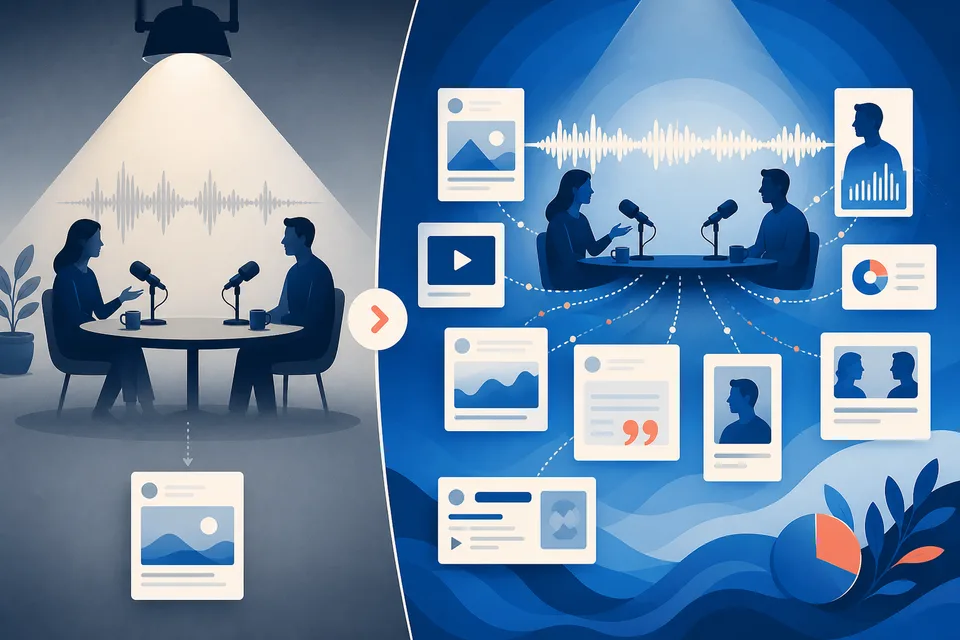
Before processing an appearance, it's fair to ask if it's worth the effort. Here's what a typical episode contains, what changes the number, and what actually determines if it's worth doing.
Your calls and interviews are already the content. SparkVox writes the posts in your voice - upload one recording and see the drafts before you're charged.
Free to sign up. Card required for full access.
No charge until day 15.