

AgenciesIntegrations
Connection Links vs Sharing Logins for Client LinkedIn
Why password vaults and screen-share OAuth do not scale for agency LinkedIn — and how SparkVox connection links keep clients in control of their credentials.
Folded into a broader retainer, LinkedIn repurposing gets no distinct line to defend at renewal. Here's what a clear, standalone service line requires - and why it depends on the production model underneath it.
 Sean Weisbrot- Founder, SparkVox
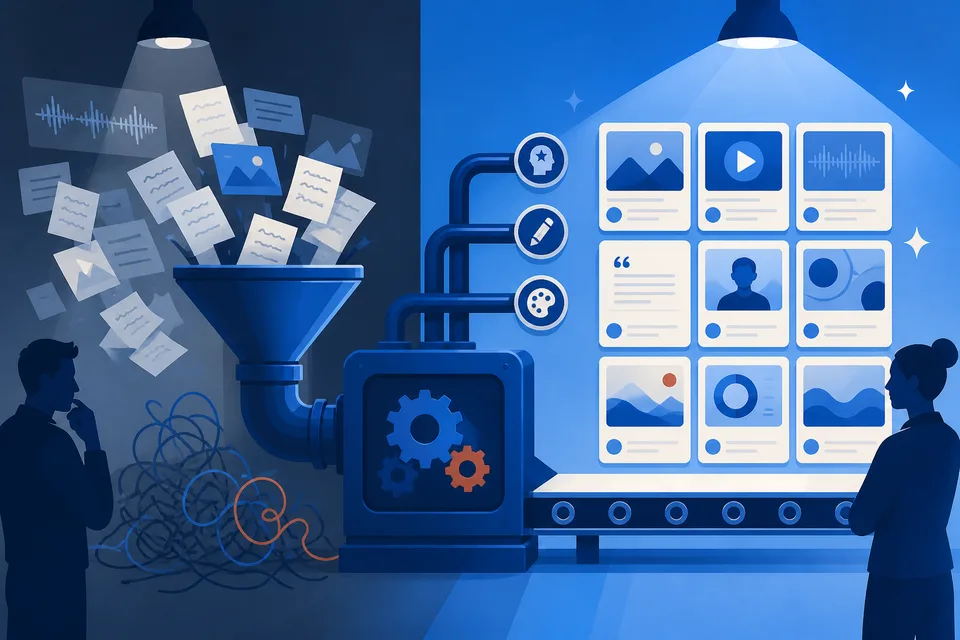
LinkedIn repurposing often gets folded into a broader retainer as an unbilled add-on - "we'll also handle your LinkedIn" - which makes it invisible on the invoice and vulnerable to being the first thing cut when a client trims scope. Billing it as its own line changes both problems at once.
A service folded into a broader retainer gets no distinct line to defend at renewal and no clear price signal to the client about its value - it's just part of "everything we do," which makes it easy to mentally discount even when it's producing real results.
A defensible per-client cost that doesn't erode margin as volume grows, and reporting specific enough to justify the line item on its own - both of which depend on the production model underneath it. A repurposing workflow where cost is processing and review time, not linear writer-hours, is what makes "here's what LinkedIn content costs, here's what it produces" a clean, standalone pitch instead of a vague inclusion.
For existing clients already receiving the service bundled in, the cleanest path is usually introducing the line item as part of a broader renewal conversation - framed as formalizing and reporting on a service they already value, not as a surprise new charge. For new clients, pricing it as its own line from day one avoids the transition conversation entirely and sets the right expectation from the start.
Instead of "LinkedIn content is part of your retainer," the pitch becomes something closer to: "here's a dedicated repurposing service, here's what it costs per month, here's the specific reporting you'll get on what it produces." That's a pitch a client can evaluate on its own merits, compare against alternatives, and renew deliberately - all things a bundled, invisible line item never gives them the chance to do.
The right number depends on the underlying production cost, not on what feels reasonable to charge - which is exactly why fixing the cost structure first matters more than picking a price in isolation. A defensible price is one that's clearly profitable against the real cost of delivering it, not a number chosen to seem fair to the client at the expense of margin.
See the underlying economics in how agencies scale client LinkedIn content without adding writers, how to report on it once it's billed separately in how to prove LinkedIn content ROI to agency clients, and how to keep it visible before the renewal conversation itself in getting client renewals to notice the LinkedIn line item.
SparkVox
Upload a call, podcast, or interview. SparkVox extracts moments and drafts up to 15 LinkedIn posts in your voice. You review every draft before anything publishes.
Free to sign up. Card required for full access.
No charge until day 15.
Why password vaults and screen-share OAuth do not scale for agency LinkedIn — and how SparkVox connection links keep clients in control of their credentials.

The kickoff call always goes well. Churn risk shows up around month two, once the honeymoon period's forgiving conditions are gone. Here's what actually determines whether month two goes well.

One account manager becomes the only person who really understands a client's voice. It works fine until they're out sick, on vacation, or gone - here's the risk that creates and how to remove it.
Your calls and interviews are already the content. SparkVox writes the posts in your voice - upload one recording and see the drafts before you're charged.
Free to sign up. Card required for full access.
No charge until day 15.