
AI ToolsContent Strategy
Your Recording Is Not 'Past Output'
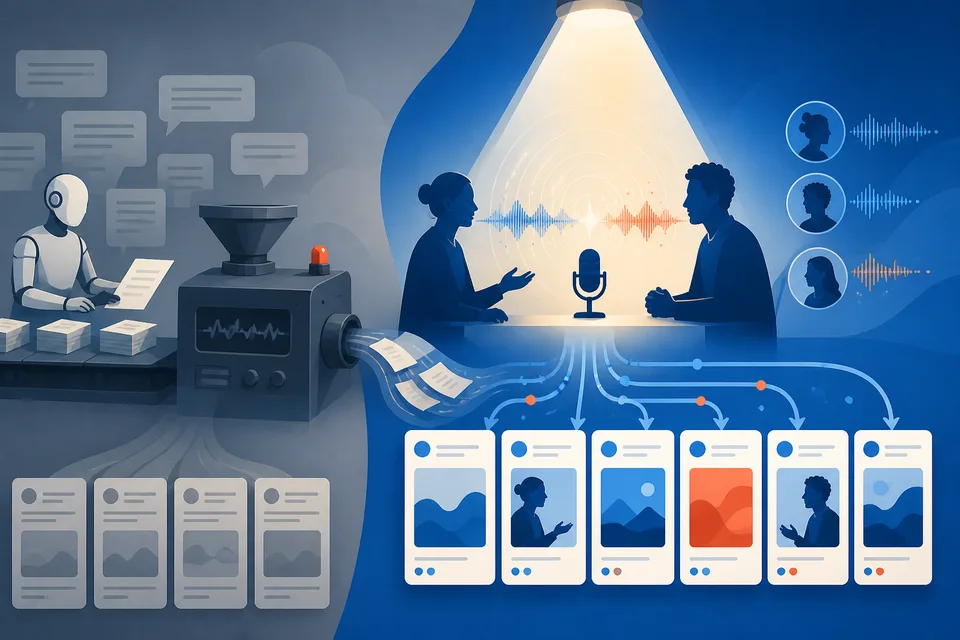
A newer wave of LinkedIn tools argues that recording-based content just recycles your past output. Here's why a real conversation is harder to fake than a scripted AI interview.
Is it cheating to publish AI-assisted LinkedIn posts? The honest answer depends entirely on where the ideas came from - and ghostwriting has answered this question for decades.
 Sean Weisbrot- Founder, SparkVox

Someone asks it eventually, usually a little sheepishly: is it cheating to use AI to write my LinkedIn posts? The question deserves a real answer instead of a defensive one, because the honest version is more interesting than either "no, don't worry about it" or "yes, and you should feel bad."
The honest answer is: it depends entirely on what the AI is doing, and most of the guilt people feel is really about a version of AI writing that is genuinely worth feeling uneasy about - just not the version they are actually using.
Underneath the question is usually a more specific fear: that the words on the post are not really theirs. That someone reading it is forming an impression of who they are based on ideas they did not have and stories they did not live. That feels dishonest, and it should - if that is what happened.
That version of AI writing is real. Type "write a LinkedIn post about resilience in leadership" into a chatbot and you will get a post about resilience in leadership, made of someone else's ideas averaged into a plausible paragraph. Post it under your name and the discomfort is earned. The thoughts in it are not yours. They are the model's best guess at what a resilience post is supposed to contain.
Here is the useful comparison: professional ghostwriting has existed for decades, and nobody calls it cheating. An executive says something interesting on a podcast or in a strategy meeting. A ghostwriter turns it into a polished LinkedIn post. The executive reviews it, edits it, approves it, and publishes it under their own name.
Nobody objects to this arrangement because the ideas in the post are genuinely the executive's. The ghostwriter did not invent the opinion - they gave it shape. The value the executive brought was the thinking. The value the ghostwriter brought was the structure and the prose. That division of labor has been normal in publishing, speechwriting, and business writing forever.
The only thing that changed is the price. A human ghostwriter costs thousands of dollars a month and works with a handful of clients. An AI system that does the same job - starting from your actual words and shaping them into a post - can do it for a fraction of the cost, for anyone, not just executives who can afford a ghostwriter.
The question worth asking is not "did AI touch this post." It is "where did the ideas in this post come from." If they came from you - a call you were on, a training you led, a podcast interview where you said the interesting thing out loud - and the AI's job was to extract and structure that material, you are in ghostwriter territory. The thinking is yours. The tool did what a good editor does.
If the ideas came from the model filling a gap you handed it with a one-line prompt, that is a different thing entirely, and it is fair to be uneasy about publishing it as if it reflects your thinking, because it does not.
Most public arguments about AI content collapse these two categories into one, because "AI wrote it" is a simpler headline than "AI helped structure content sourced entirely from what a real person actually said." The nuance does not perform as well as the outrage. That does not make the nuance less real.
SparkVox is built around the ghostwriter version of this on purpose. Every post starts from a recording of you - a sales call, a training, a podcast, an interview - and Sparky's job is to extract the moments worth posting and structure them, not to invent opinions you never had. You review and approve every draft before it goes live. The ideas are yours. The tool did the part a ghostwriter would have done.
For more on this distinction, read AI-generated vs. AI-assisted content and why the loudest "AI is ruining LinkedIn" takes usually skip this exact point.
SparkVox
Upload a call, podcast, or interview. SparkVox extracts moments and drafts up to 15 LinkedIn posts in your voice. You review every draft before anything publishes.
Free to sign up. Card required for full access.
No charge until day 15.
A newer wave of LinkedIn tools argues that recording-based content just recycles your past output. Here's why a real conversation is harder to fake than a scripted AI interview.
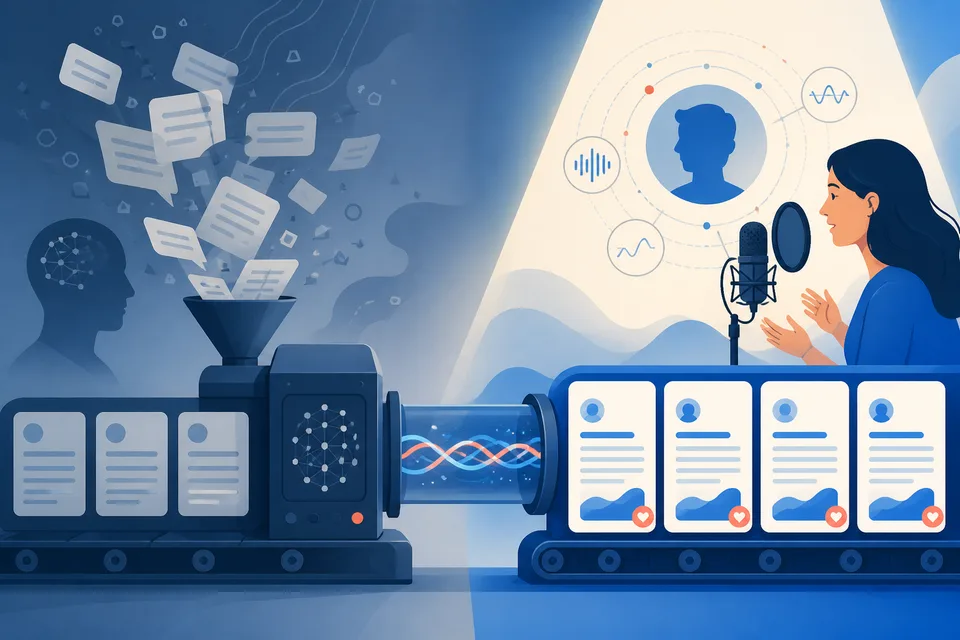
AI-written LinkedIn posts have specific, spottable tells - and they come from the input, not the model. Here's why content sourced from real recordings avoids them structurally.

Advice written cold for LinkedIn often comes out softer than it did in the actual client conversation. Here's why the room and the feed produce different versions, and what that costs.
Your calls and interviews are already the content. SparkVox writes the posts in your voice - upload one recording and see the drafts before you're charged.
Free to sign up. Card required for full access.
No charge until day 15.