
AI ToolsContent Strategy
Why Recording-First Posts Don't Sound Like AI
AI-written LinkedIn posts have specific, spottable tells - and they come from the input, not the model. Here's why content sourced from real recordings avoids them structurally.
A newer wave of LinkedIn tools argues that recording-based content just recycles your past output. Here's why a real conversation is harder to fake than a scripted AI interview.
 Sean Weisbrot- Founder, SparkVox
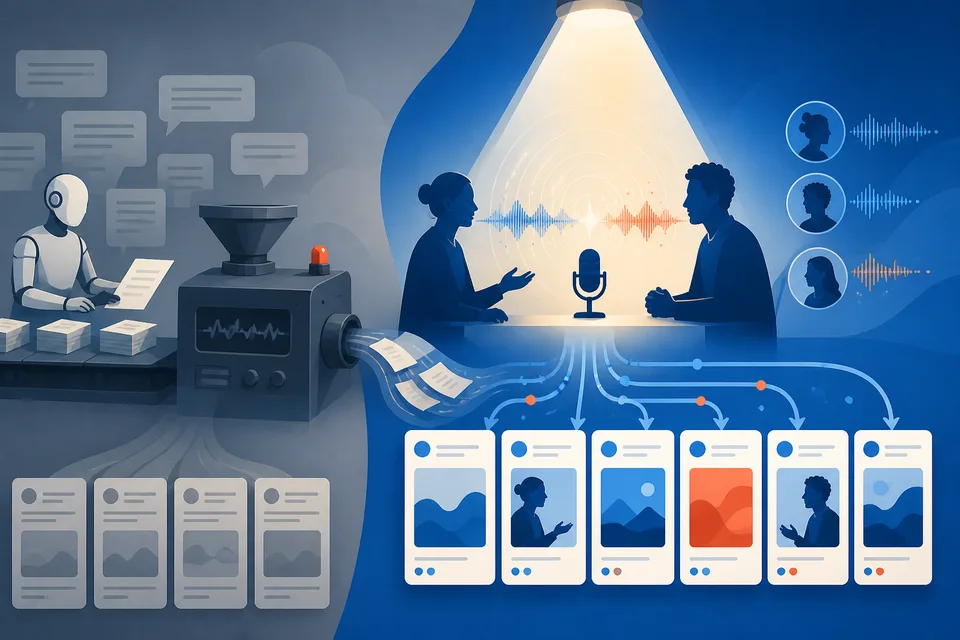
A newer wave of LinkedIn content tools has started making a specific argument against anything built on your recordings or your history: that it is backward-looking. The pitch goes something like this - a guided AI interview pulls fresh thinking out of you right now, while a tool that learns from what you already said is just recycling the past.
It is a clever pitch. It is also wrong about where good LinkedIn content actually comes from.
The case against recording-based tools sounds reasonable on the surface: your thinking evolves, so a system trained on old material will always be a step behind who you are now. A live interview, by contrast, meets you where you are today and extracts something new.
The flaw is in what counts as "old material." A sales call from last Tuesday is not archival footage. A podcast interview you recorded this morning is not a dusty transcript. These are not artifacts of who you used to be - they are the most recent, most pressure-tested version of your thinking that exists.
Think about what actually happens on a sales call or in a podcast interview. A prospect pushes back with a real objection you did not expect. A host asks a follow-up question that forces you to explain something you normally take for granted. You reach for an analogy on the fly because the person in front of you did not understand your first explanation.
None of that happens in a guided AI interview. A structured Q&A flow, however well designed, is still a performance for a system that is trying to extract content. You know you are being interviewed. You are, on some level, composing an answer that will become a post - which is exactly the kind of self-conscious framing that produces the generic, slightly-too-polished tone LinkedIn audiences have learned to scroll past.
A sales call has no such self-consciousness. Nobody on that call was thinking about their personal brand. They were solving a problem. That is precisely why the best material for a LinkedIn post - the specific objection, the unscripted analogy, the moment someone changed their mind - shows up there and not in an interview designed around content generation.
The framing only holds up if you accept a strange definition of "past" - one where a recording from an hour ago counts as history, but an answer you just gave to an AI's prompt counts as present. Both are things you said a moment ago. The difference is not recency. It is whether a real person was on the other end of it.
A voice profile built from real conversations is not stuck in amber. Every new recording - every call, every training session, every podcast episode - adds to it. The profile you have next month reflects what you said next month, not a snapshot frozen at signup. That is what compounding actually means: it gets closer to you over time, not further away.
If you have to choose between a tool that draws from what you said in a real conversation this week and one that draws from what you said to a chatbot pretending to interview you this week, the recording wins - not because it is newer, but because nobody was performing for content when it was said.
SparkVox is built around that distinction. Upload a call, a training, an interview, or a podcast, and Sparky extracts the moments worth posting from what actually happened - not from a Q&A flow designed to sound like you on command. See how that plays out directly in SparkVox vs Meet Sona, or read how to make AI LinkedIn content actually sound like you.
SparkVox
Upload a call, podcast, or interview. SparkVox extracts moments and drafts up to 15 LinkedIn posts in your voice. You review every draft before anything publishes.
Free to sign up. Card required for full access.
No charge until day 15.
AI-written LinkedIn posts have specific, spottable tells - and they come from the input, not the model. Here's why content sourced from real recordings avoids them structurally.

Is it cheating to publish AI-assisted LinkedIn posts? The honest answer depends entirely on where the ideas came from - and ghostwriting has answered this question for decades.

Advice written cold for LinkedIn often comes out softer than it did in the actual client conversation. Here's why the room and the feed produce different versions, and what that costs.
Your calls and interviews are already the content. SparkVox writes the posts in your voice - upload one recording and see the drafts before you're charged.
Free to sign up. Card required for full access.
No charge until day 15.