

Expert GuestsPodcast
How Speaker Diarization Stops Expert Guests From Posting the Host's Lines
Interview repurposing fails when the tool cannot tell who spoke. Here is how SparkVox lets you pick your voice before posts generate.
A podcast episode contains eight to fifteen standalone post ideas. Most founders extract zero. Here is the full workflow - manual extraction, the voice problem, funnel-aware repurposing, and a worked example.

Podcast appearances are one of the most underleveraged content assets in B2B. You spend an hour sharing frameworks, telling stories, and sharpening arguments you have developed over years. The host's audience hears it once. Your LinkedIn network sees nothing - or at best, a single link post that reads "just dropped a new episode."
The good news: a single podcast episode contains enough material for ten to fifteen LinkedIn posts. The challenge is extraction. Most people don't do it because the workflow feels heavy. This post walks through the full process, including what usually breaks and how to fix it.
Think about how a podcast episode compares to other content you produce. A blog post takes two hours to write and contains one or two strong ideas, heavily edited. A LinkedIn post takes fifteen minutes and contains one idea. A podcast episode takes an hour - and if you were really in it, it contains eight to twelve distinct insights, each one a standalone post.
The math is obvious once you see it. The problem is format. Raw conversation is not LinkedIn copy. To extract value, you have to listen back, identify moments, and write each one up as its own post. Most people never do step one. The episode sits in Spotify and they move on.
Expert guests - consultants, coaches, and executives who appear on other people's shows - feel this most acutely. They did the hard part on the mic. Their own network never saw the frameworks they shared or the questions that landed.
If you want to extract podcast content without any tool, the process has four steps:
Done right, one episode produces a week or more of posts. Done wrong, it produces one long summary thread that reads like a recap rather than original content.
The most common mistake is treating the episode as the unit of content. People write about the episode ("in this conversation, we covered...") instead of writing from the episode ("the thing nobody tells you about cold outreach is...").
This produces posts that are about your appearance rather than about the ideas in your appearance. Your network does not care that you were on a podcast. They care whether the post they are reading right now is worth reading.
Other common failure modes:
Pasting a transcript into a general-purpose AI tool and asking for LinkedIn posts produces output that sounds like every other AI-generated LinkedIn post: numbered lists, em dashes between every two words, openings like "here's what nobody tells you about X."
The problem is not the AI. It is the input method. A generic prompt produces generic output because the model has nothing to draw on except the transcript and its training data. It has no sense of how you typically open a post, what topics you return to, how direct you are, whether you lean into data or lean into story. It fills those gaps with what it has seen most often - and what it has seen most often is the median LinkedIn post, not yours.
Voice-accurate repurposing requires more than a transcript. It requires a model that has read enough of your actual output to know what you sound like when you're at your best, not what you sound like when an AI is approximating your voice.
Every podcast episode contains moments that serve different purposes in your content strategy. Not every post from an episode should work the same job:
One episode usually contains all three. A good repurposing workflow surfaces all of them and labels them so you are not accidentally posting five authority pieces in a row while ignoring reach.
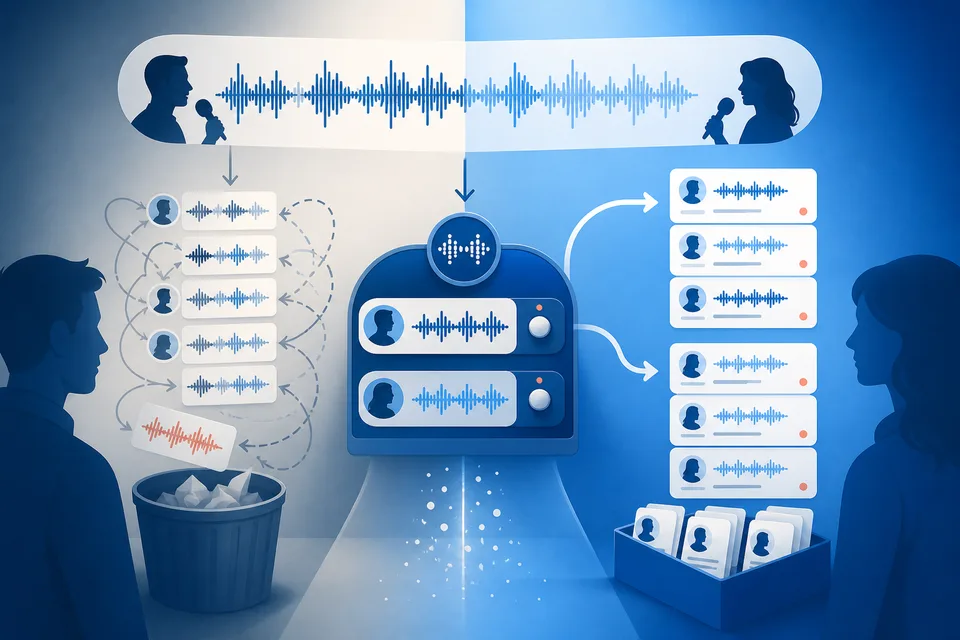
SparkVox takes the full episode audio, video, or transcript and extracts up to fifteen moments - each one a distinct insight that stands on its own as a LinkedIn post. For guest appearances, it uses speaker diarization to isolate your voice from the host's, so posts come from what you said, not from questions you were asked.
Each draft is grouped by funnel stage: Awareness, Authority, or Conversion. You review in your project, edit what needs sharpening, and approve. Nothing publishes without your pass. Every transcript you process deepens your voice profile; every edit you make before approving teaches Sparky your style corrections for the next project.
For a deeper look at the full repurposing workflow, see how to repurpose content for LinkedIn.
Here is how the same moment from a podcast episode becomes three different posts depending on the funnel stage:
The original moment (from a founder discussing fundraising): "We got 27 nos before we got our first yes. The no from Andreessen came on a Tuesday. We had nine thousand dollars in the bank."
Awareness post. Lead with the contrast: "27 nos before the first yes. Most people quit at five." This post earns reshares because it is a clean provocation. No context required. The reader does not need to know you or your company to find it interesting.
Authority post. Extract the process: "We tracked every rejection in a spreadsheet. Objection, firm, partner name, meeting length. By rejection 12, we could predict which objections were really nos and which were 'come back in six months.' Here is how we read them..." This post earns saves and profile visits because it is genuinely useful.
Conversion post. Make the stakes concrete: "You do not need to be fundable to raise. You need to be visible to the people who will fund you. Eighteen of those 27 firms met us because someone they knew posted about us on LinkedIn. I have written a lot about how that happened." This post earns DMs and connection requests because it creates a reason to reach out.
Three different posts, one moment, one episode. That is the leverage point most people miss when they repurpose a podcast. For founders and consultants who appear on multiple shows per month, this approach turns a podcast calendar into a content engine without adding any recording time.
SparkVox
Upload a call, podcast, or interview. SparkVox extracts moments and drafts up to 15 LinkedIn posts in your voice. You review every draft before anything publishes.
Start 14-day Pro trial →Free to sign up. Card required for full access.
No charge until day 15.
Interview repurposing fails when the tool cannot tell who spoke. Here is how SparkVox lets you pick your voice before posts generate.

A single conversation contains more content than most people publish in a month. Here's the system for extracting every piece of it, starting with the you capture right after.

Upload a transcript or recording as a SparkVox project, extract moments into LinkedIn posts in your voice, and review everything in your project's LinkedIn content strategy before you publish.
Your calls and interviews are already the content. SparkVox writes the posts in your voice - upload one recording and see the drafts before you're charged.
Start 14-day Pro trial →Free to sign up. Card required for full access. No charge until day 15.