

Social SellingAI Tools
Best Social Selling Tools in 2026
Sales Navigator, Taplio, Castmagic, SparkVox - social selling tools solve different jobs. A category-by-category breakdown so you pick the right one instead of the loudest one.
Most social selling initiatives die in week three because reps do not have time to write. Here's how growth marketers can run a program that survives past the kickoff deck.
 Sean Weisbrot- Founder, SparkVox

You do not carry a quota, but you own the social selling number leadership asks about at the QBR. That is an uncomfortable position: you are responsible for a program whose output depends entirely on whether a dozen individual reps feel like writing LinkedIn posts this week. Most growth marketers inherit this exact setup, and most social selling initiatives die inside a quarter because the program was designed around motivation instead of around the actual bottleneck.
Kickoff decks for social selling programs are full of stats about pipeline influence and buyer trust, and reps generally agree with the premise. The problem shows up in week three, when the calendar template sits untouched because nobody carved out the twenty minutes a post actually takes to research, draft, and edit. A program built on "reps should post because it works" collapses the moment reps get busy - which is always.
The programs that survive are built around a different premise: reps already generate the raw material for great posts every week, on calls they were going to take anyway. The job is not "get reps to write." It is "get the writing out of a source that already exists."
Traditional social selling programs hand reps a content calendar: Monday is an industry insight, Wednesday is a customer story, Friday is a personal reflection. That structure assumes reps have ideas on tap. They do not - not because they lack expertise, but because pulling a specific, credible idea out of thin air on a Tuesday is genuinely hard.
Flip it. Every discovery call, demo, and customer conversation a rep takes already contains an objection they handled well, a framework they explained clearly, or a result a customer described in their own words. That is the content calendar - it is just sitting in a call recording instead of a spreadsheet. See how to turn sales calls into LinkedIn content for the extraction mechanics.
A single shared voice across ten reps' LinkedIn accounts reads as obviously templated - buyers notice when five people on the same sales team post in an identical cadence and tone within the same week. Each rep's content needs to sound like that rep: their phrasing, the deals they focus on, how direct they are. A program that centralizes writing into one marketing-owned voice trades authenticity for control, and authenticity is the entire point of social selling.
That is also why a compounding voice profile per person matters more here than in most content workflows - it is the difference between ten reps sounding like themselves and ten reps sounding like the same AI wrote all of it.
A dashboard full of "posts published" numbers looks good in a report and says nothing about whether the program is working. What matters is the mix: are reps publishing Awareness posts that reach new audiences, Authority posts that build category trust, and Conversion posts that prompt a reply - not five variations of the same post type. See the LinkedIn content funnel for how to read the mix, and the engagement playbook for what happens after a post goes live.
A concrete version of the pilot approach below: weeks one and two, six reps connect their notetaker (Fireflies, Fathom, Zoom, or Google Meet) and each approves their first two drafts from real calls - most need a short 1:1 walkthrough, not a training session. Weeks three and four, drop-off shows up here if it is going to - watch per-rep posting frequency, not team totals, and follow up individually with anyone who has gone quiet rather than sending a team-wide reminder. Weeks five through eight, the reps still active have usually settled into a rhythm and their drafts need less editing each week as the voice profile compounds. By week eight, you know whether the mechanism holds without you pushing it - that is the signal to expand to the next group, not the size of the kickoff deck.
Do not promise leadership a direct revenue number from social selling in the first quarter - that is not how trust-building content works, and overpromising it is how programs get killed after one bad reporting cycle. What you can credibly track: pipeline where the buyer mentions having seen the rep's content before the first call, reply rates on outreach sent to prospects who have already engaged with a post, and inbound messages that reference something a rep published. Tag these in your CRM as "social-influenced," distinct from "social-sourced" - most of the value shows up as an assist on a deal that started somewhere else, not as a lead that originated from a single post.
Three numbers tell the real story of a social selling program: how many reps are actively publishing (not just enrolled), how consistent that publishing has been over the quarter, and whether engagement is trending toward the accounts that match your ICP. Vanity impressions on a handful of viral posts from your two most enthusiastic reps do not represent program health - a flat but consistent cadence across the whole team does.
Post-level analytics per rep, not just aggregate totals, is what makes this reportable. If your current stack cannot show you who is actually posting and what is landing, you are reporting on effort instead of outcome.
Each rep gets their own SparkVox account and voice profile, so posts stay authentically theirs while you keep a program-wide view of adoption and performance through Post Analytics. Reps upload or connect their calls; you get a system that runs without a weekly Slack reminder. See SparkVox for social selling for the full workflow, or compare options in the best social selling tools in 2026.
SparkVox
Upload a call, podcast, or interview. SparkVox extracts moments and drafts up to 15 LinkedIn posts in your voice. You review every draft before anything publishes.
Free to sign up. Card required for full access.
No charge until day 15.
Sales Navigator, Taplio, Castmagic, SparkVox - social selling tools solve different jobs. A category-by-category breakdown so you pick the right one instead of the loudest one.

The best rep on a team is often the least excited about a social selling mandate. Here's why sales skill and writing comfort are different muscles, and what that means for program design.
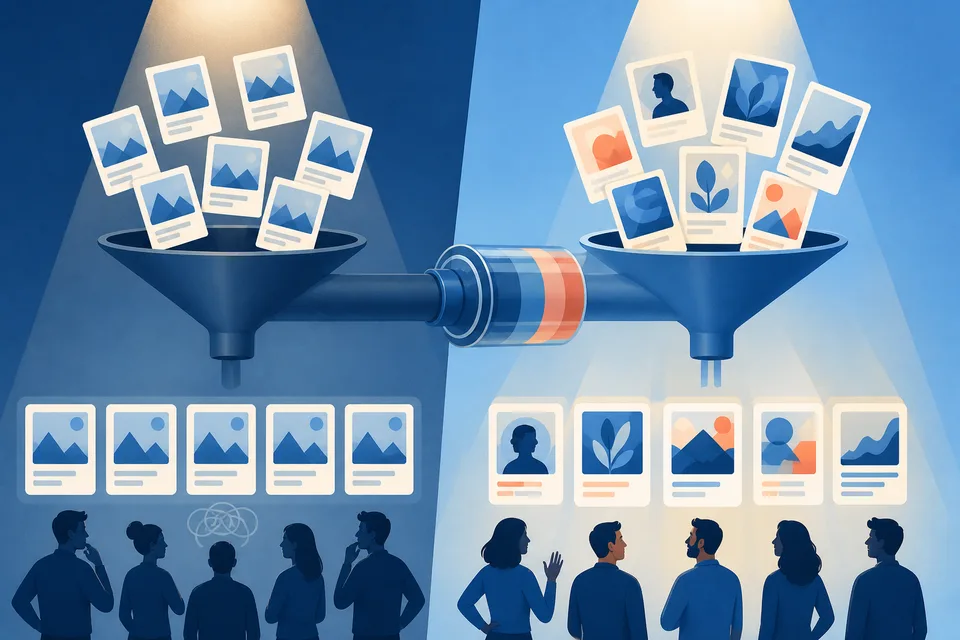
Left unstructured, a program tends to converge on one kind of post. Here's why unstructured output drifts toward sameness, and what calibrating drafts to specific goals changes.
Your calls and interviews are already the content. SparkVox writes the posts in your voice - upload one recording and see the drafts before you're charged.
Free to sign up. Card required for full access.
No charge until day 15.