Most AI writing tools solve the "sounds generic" problem the same way: you describe your voice, and the model tries to imitate the description. Upload a style guide. Answer a few tone questions. Paste some sample posts. The tool now has a summary of how you write, and it does its best to match it.
That approach works better than a blank prompt. It also has a ceiling, and the ceiling is the description itself.
A description of your voice is not your voice
Ask yourself how you would describe your own writing style out loud. Most people land on something like "direct, a little informal, likes short sentences." That is true, and it is also nearly useless as an instruction. It does not capture the specific phrase you always reach for when you are annoyed. It does not capture the rhythm of how you build to a point over three sentences instead of one. It does not capture the story you tell every time someone asks about your first year in business.
A style guide is a summary written by someone trying to compress a personality into adjectives. The compression is where the voice gets lost. Feed a model "direct, a little informal, likes short sentences" and you get output that is direct, a little informal, and full of short sentences - and generic in exactly the way every other founder's AI-summarized voice guide is generic, because there are only so many adjectives.
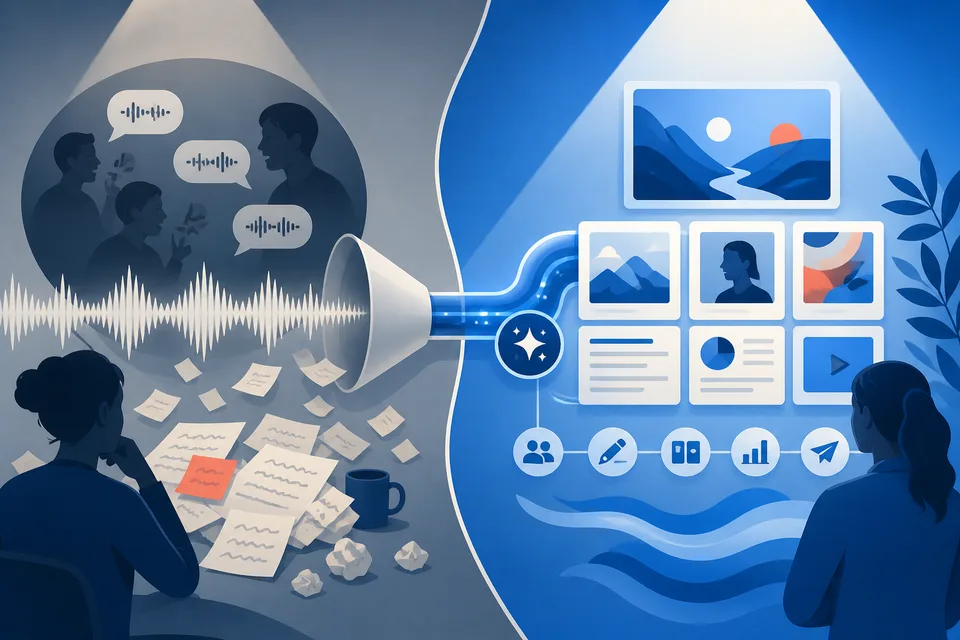
A transcript is not a summary of your voice. It is your voice.
The alternative is not a better description. It is skipping the description entirely.
A transcript of you talking on a sales call or a podcast contains the actual sentence structures you use, not an adjective standing in for them. It contains the phrase you repeat without noticing. It contains where you pause, where you get more animated, which analogies you reach for under pressure. None of that survives translation into a style guide, because none of it is the kind of thing you would think to write down about yourself.
This is the difference between telling a ghostwriter "I'm pretty casual" and handing them three hours of you actually talking. One gives them an instruction to follow. The other gives them the material itself.
Why this matters more than it sounds like it should
Tools built on style guides and Brand Voice settings are not wrong to exist - they are solving a real problem for teams that need consistent output across many writers with no single source of truth to draw from. But for an individual voice, a configured description is always going to be a lossy compression of something a real transcript captures directly.
It also explains a pattern worth watching for: tools that lean on Brand Voice settings tend to produce output that needs meaningful editing to feel personal, even after careful setup. The voice was never really captured. It was described, and description has a floor on how specific it can get.
SparkVox skips the description step
SparkVox does not ask you to describe your voice. Sparky builds your voice profile from the transcripts of what you actually said, plus every draft you approve or edit - not from a questionnaire or a pasted paragraph of adjectives. The source material is the thing itself, not a summary of the thing.
See this play out directly against a style-guide-driven competitor in SparkVox vs Jasper, or read how to make AI LinkedIn content actually sound like you for the fuller picture of what a compounding voice profile does differently.