On this page
Impressions are the first number most people see on LinkedIn analytics, and one of the most misunderstood. An impression is not a read. It is not a like. It is not proof that someone cared about your post. It is simply a count of how many times your content appeared on a screen. Understanding that distinction saves you from optimizing for a metric that often flatters more than it informs.
The plain definition
LinkedIn counts an impression each time your post is displayed on someone's feed, on your profile activity, or in another surface where the post can be viewed. If the same person scrolls past your post twice in separate sessions, that can count as two impressions. If your post appears while someone is scrolling quickly and they never pause, it still counts.
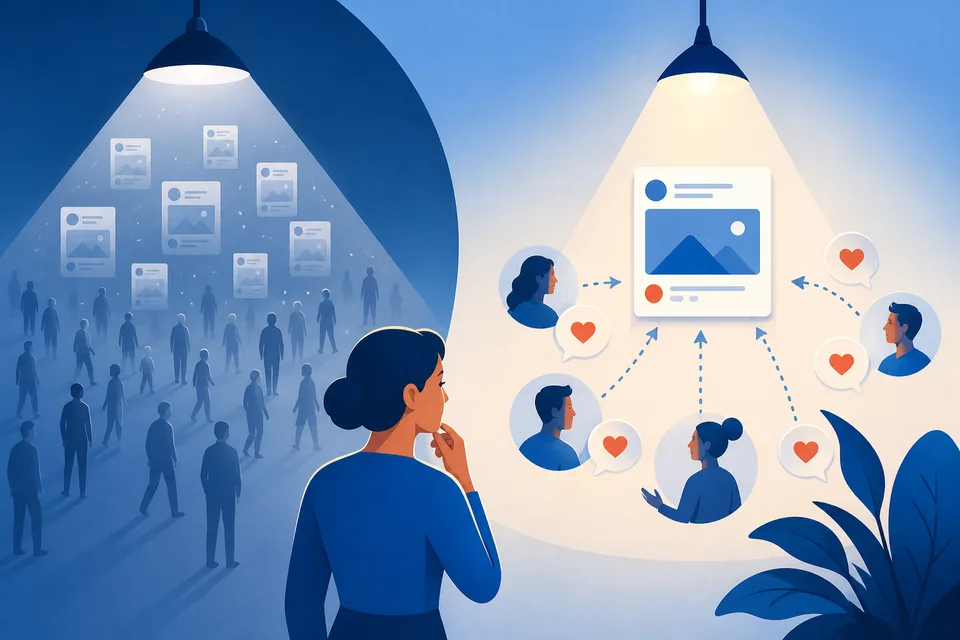
Impressions measure visibility, not attention. Visibility is a prerequisite for attention, but the gap between them is where most LinkedIn strategy goes wrong.
Impressions vs reach vs members reached
LinkedIn surfaces several related numbers. They sound interchangeable. They are not.
- Impressions - total times the post was shown. Can exceed your follower count because one person can generate multiple impressions and because posts can reach beyond your network.
- Members reached (sometimes shown as unique viewers) - how many individual LinkedIn accounts saw the post at least once. Always lower than or equal to impressions unless the UI rounds oddly on small posts.
- Followers gained - net new followers attributed to the post window. A lagging indicator, not a real-time impression cousin.
When impressions are 10x members reached, either the post got heavy repeat exposure to the same people (common in dense networks) or the post stayed visible in feeds long enough for repeat views. Neither case automatically means the post "went viral" in a useful way.
What counts as an impression (and what does not)
LinkedIn does not publish a line-by-line spec for every edge case, but in practice:
- Counts: feed appearances, profile activity views, some reshares where your original post is embedded, company page feed distribution.
- Often does not count the way people assume: someone reading only the first two lines without the post fully loading, notifications that never get opened, or previews in tools outside LinkedIn's own analytics.
- Engagement is separate: likes, comments, reposts, and clicks are their own events. A post with high impressions and zero engagement told the algorithm something went wrong after the first second.
Company pages vs personal profiles
On personal profiles, impressions reflect the mix of your first-degree network, second-degree reach when engagement triggers redistribution, and occasional off-network discovery. Personal posts live or die on early engagement from people who already know you.
On company pages, impression patterns differ. Follower bases are smaller and colder. You may see higher impression-to-engagement ratios on proof posts and lower profile-view spikes. Some analytics views also show unique impressions on company content - useful for seeing repeat exposure vs new eyeballs on employer brand posts.
Compare channels separately. Mixing personal and company metrics into one headline number hides which identity is doing the work. See how to read company page vs personal analytics.
Why impressions go up (and why they stop)
LinkedIn tests new posts on a slice of your audience first - often your followers and people with recent interaction history. If early signals are strong (comments, dwell time, profile clicks), distribution expands. If they are weak, the post dies quietly with "fine" impressions that never compound.
That is why the first 90 minutes matter, why your first line affects dwell time, and why a mismatched audience can poison the test before you even know what happened. Raw impressions without context do not tell you which case you are in.
When impressions are useful
- Trend over time. Are your typical posts gaining or losing visibility month over month on the same channel?
- Relative comparison. Which topics or formats consistently earn more impressions for your account, not versus influencer benchmarks?
- Denominator for rates. Engagement rate = engagements divided by impressions. Without impressions, you cannot compute whether 40 reactions is strong or weak.
- Decay curves. Tools that sync direct LinkedIn publishes can plot how impressions accumulate day 0, 1, 2, and 7 - useful for timing and consistency decisions.
When impressions mislead you
A post with 25,000 impressions sounds impressive until you ask who those people were. I wrote about that gap in why 25,000 impressions meant nothing: most viewers were irrelevant to my business, and the meaningful number was a few hundred founders and executives, not the headline count.
Chasing impressions also pushes you toward broad, generic content that attracts the wrong followers - which then hurts the next post's early engagement test. Volume without relevance compounds against you.
What to track alongside impressions
- Engagement rate (reactions + comments + reposts relative to impressions)
- Profile views on days you publish (especially for personal identity)
- Comments from people in your ICP - quality beats quantity
- Audience composition when LinkedIn exposes title or industry breakdowns
- Funnel stage - awareness posts and conversion posts should not share one impression benchmark. See structuring content by funnel stage.
Where SparkVox fits
SparkVox Post Analytics syncs metrics for posts you publish directly to LinkedIn through the app: impressions, engagement rate, clicks, comments, and posting-impact charts correlated with profile views. Weekly reports and What's Working rankings help you see which themes earn reach and engagement on your personal profile or company pages - not just which post got the biggest vanity number.
Impressions answer "how many times did this show up?" The strategy question is "did the right people see it, and did anything happen next?" Start there, and the impression count becomes a tool instead of a trophy.