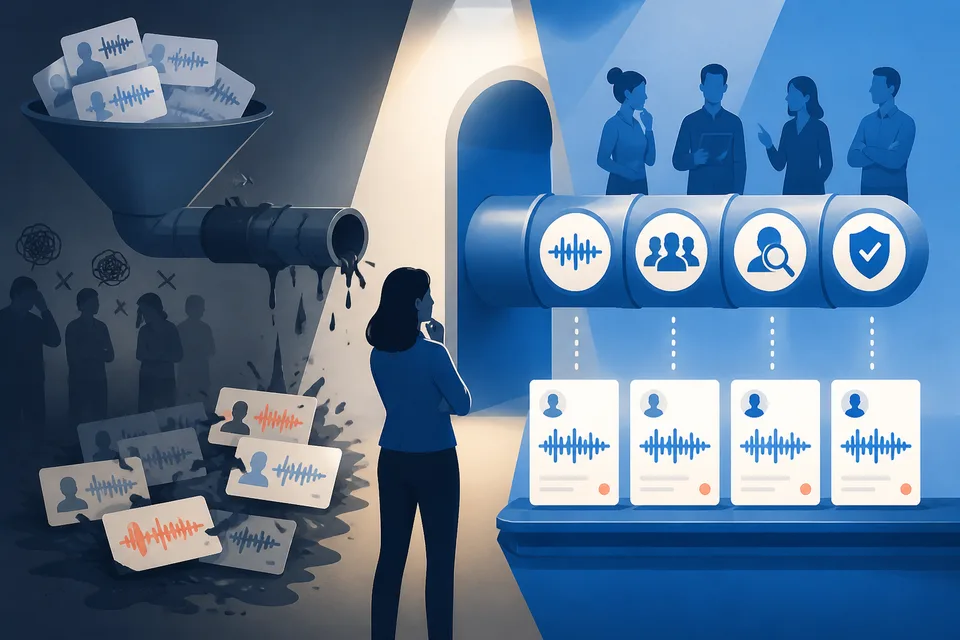
Handing a client's LinkedIn voice to any tool is a real trust decision, not a minor workflow choice - a bad output publishes under a real person's name, in public, and a firm is accountable for it either way. Before adopting any repurposing tool, a few questions are worth asking directly.
A shared tone across every client account is the single most common failure mode - it reads as inauthentic almost immediately, since no two clients actually sound alike. Ask specifically whether voice profiles are isolated per account, not just per prompt.
What happens with multi-speaker recordings?
Interviews, panels, and client calls all have more than one voice in them. A tool without explicit speaker selection risks attributing someone else's words to your client - ask how the tool distinguishes speakers before anything drafts, not after.
Is there a mandatory human review step before anything publishes?
No automated drafting process should be able to publish without a person approving first. Confirm this is structurally required, not just a recommended best practice a team could skip under deadline pressure.
Can the firm actually prove the content is working?
A tool that can't produce real, verifiable engagement data leaves account leads defending the retainer with impressions of quality instead of numbers. Ask whether reporting pulls from the platform's own official data or from something reconstructed by hand.
A fifth question worth adding: what happens if a client leaves?
Ask what happens to a client's voice profile and content history if the relationship ends - whether the account and its data belong to the firm managing it, or whether ownership is ambiguous. This matters more than it might seem to at signup, since it determines whether the firm retains any value from months of accumulated voice-profile work if a client relationship changes, and it's a much easier question to ask before adopting a tool than to resolve after the fact.
Why it's worth running these questions past more than one vendor
A vendor's own answers to these questions are useful, but comparing answers across two or three options makes gaps more visible than evaluating any single tool in isolation - a weak answer on speaker handling, for instance, is easier to spot as weak once a competitor's answer to the same question is markedly stronger. Treating this as a short comparison exercise rather than a single vendor evaluation surfaces more than asking one provider these questions alone.
See how SparkVox answers each of these on SparkVox for PR firms, and the reporting side specifically in reporting placement impact to clients who ask what did that interview actually do, or the full comparison against a freelance writer in SparkVox vs a freelance writer for client placement content.