On this page
There is a pattern to AI-generated LinkedIn posts that readers have learned to detect at a glance. The hook is a numbered list or a rhetorical question. The paragraphs are balanced to within a sentence of each other. The vocabulary is slightly too correct. The opinions are well-reasoned and entirely inoffensive. And somewhere in the post there is a phrase like "in today's rapidly evolving landscape" or "it is more important than ever."
Most people's response to this is to try to write better prompts. Add more personality. Tell the AI to avoid clichés. Give it examples of your style. Paste in a sample post. Upload your LinkedIn profile. These are all cosmetic fixes. They do not address the underlying reason AI-generated content sounds like AI-generated content.
The problem is not the words. The problem is the input. And fixing the input requires rethinking the architecture of how you generate posts, not refining the instructions you give a prompt tool.
Why the usual fixes don't work
When you give a general-purpose AI a style guide or sample posts, you are asking it to imitate a writing style from the outside. The model looks at vocabulary choices, sentence rhythm, paragraph length, and tone markers, and tries to reproduce them. This produces something that superficially resembles your writing but lacks the thing that makes your writing actually yours: the specific stories, data, clients, moments, and turns of phrase that only come from living through your professional life.
Scraping your published LinkedIn posts makes this worse in a specific way. Your published posts are a curated, performative version of how you communicate. They are how you present yourself when you know you have an audience. They are not how you think, how you explain things when you're in the middle of a client call, or how you describe your category when someone you respect is genuinely curious about it. Scraping the polished output and calling it your voice captures the costume, not the person wearing it.
Tools that offer "style learning" or "content DNA" face the same ceiling. They learn from text you supply and posts you approve. Text you supply is still you composing for an audience. The loop never gets to your unconstructed, unrehearsed communication - the mode you're actually in when you do your best thinking out loud.
The three-level problem with prompts
Prompt-based generation fails at three distinct levels, each compounding the last.
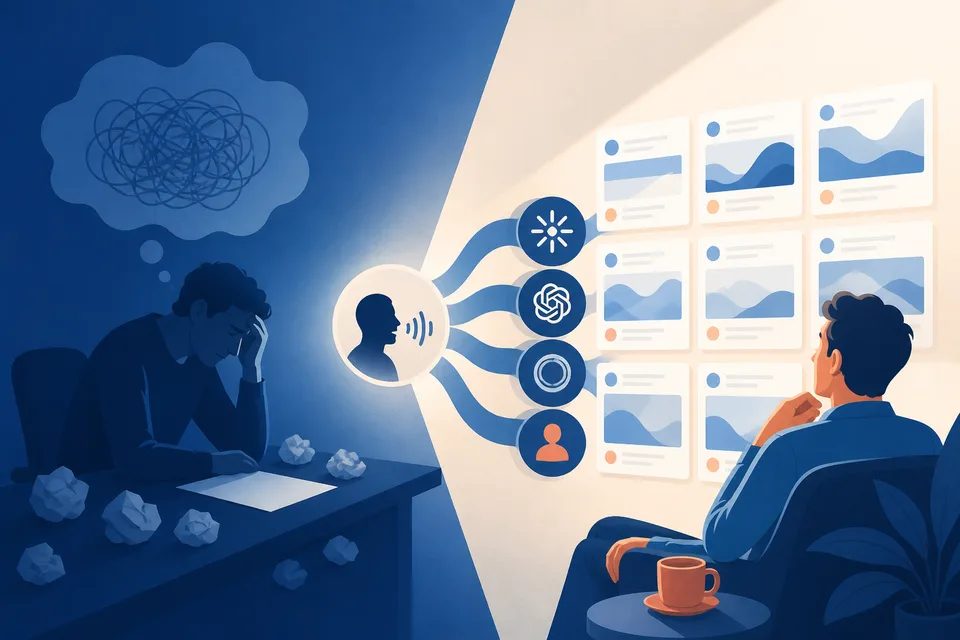
Level one: prompts start from zero every time. When you open a new chat and type "write me a LinkedIn post about how I help my clients," you are giving the model nothing to work with except your instruction. It reaches for the statistical average of every LinkedIn post it has ever seen on the general topic. The output is competent, inoffensive, and completely devoid of anything only you could have said. No one else's client story. No specific result. No phrase that reflects how you actually talk.
Level two: style learning plateaus fast. Even if you paste twenty of your best posts and say "write like this," the model learns surface patterns: your average sentence length, some vocabulary preferences, a rough structural template. It does not learn that you always start a story with the specific moment things went wrong. It does not learn that you never use the phrase "passionate about" but often say "I care about the problem." It does not learn the rhythm of how you build to a point when you're talking versus when you're writing. Those things require volume and depth of input, not a handful of examples.
Level three: there is no compounding. Every session with a prompt tool resets. Your corrections do not carry forward. If you edited an output and removed three phrases you never actually use, that correction informs nothing about the next post. You are prompt-engineering from scratch every time you open the tab. The tool does not get better at you. You get incrementally better at prompting, which is a skill that takes time and produces inconsistent results.
The architectural fix: source from recordings
The reason recordings solve this problem is not because audio is a better input format than text. It is because recordings capture a specific mode of communication that text never reaches: the unrehearsed, conversational version of your expertise.
When you are in a sales call explaining why a prospect's current approach is failing, you are not composing. You are thinking out loud in response to a specific person with a specific situation. Your vocabulary is natural. Your sentence structure reflects how you actually reason, not how you edit yourself for public performance. You reach for the example you have used successfully before, tell the story with the details that made it land, and use the phrases that are genuinely yours because they came out of your mouth, not from a blank text box.
That recording contains your actual voice. Not your curated voice. Not the voice you perform for LinkedIn. The voice you use when you know your subject and are trying to be genuinely useful to another person.
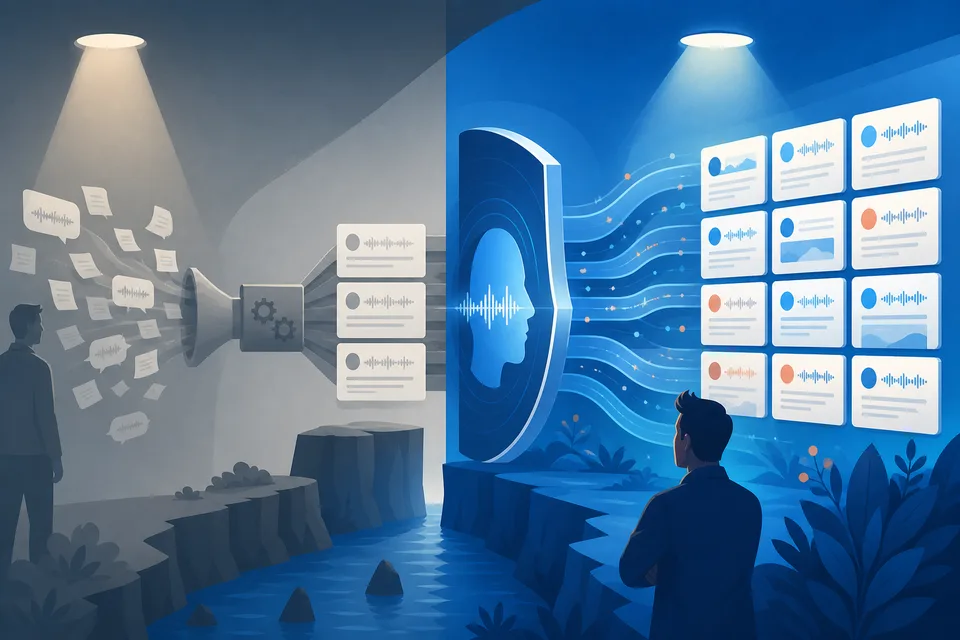
When you transcribe that recording and extract content from it, the first-person specificity is already in the source material. The story happened. The framework was explained to a real client. The objection was answered in real time. A tool that extracts posts from transcripts is not inventing these things from a prompt - it is surfacing them from your own words.
Why the learning loop changes everything
The second part of the architectural fix is compounding. A voice profile built from transcripts grows more accurate with every project.
Not because the model is getting smarter in general. Because it is getting more precise about you specifically. After twenty recordings, it has seen patterns in how you open stories, the length you prefer for body paragraphs, the phrases you return to in different contexts, and the ones you consistently edit out. When you approve a draft as-is, that signals a match. When you change a specific sentence before approving, that edit is a correction that informs future drafts.
This is different from prompt refinement in a fundamental way. Prompt refinement improves your instructions. A compounding voice profile improves the model's understanding of your actual output. The end state of prompt refinement is a better prompt. The end state of voice profile compounding is a draft that sounds like you on your best day without you doing anything except uploading the recording and reviewing the result.
What this looks like in practice
A 45-minute sales call contains multiple publishable LinkedIn posts. Not because you said something brilliant. Because you explained something clearly, told a story that worked, or answered an objection in a way that crystallised what you actually believe. Those moments are in the recording.
When you process that recording through a transcript-first tool, you get posts that contain your specific data, your client's actual situation (anonymised), your explanation of the problem, and your framework for solving it. The language is yours because the source material was yours. No prompting, no template-filling, no style guide required.
Readers can tell the difference. Not because they're running your content through an AI detector, but because the specificity is there. The number is real. The situation is recognisable. The phrase in the hook is one only someone who has lived this would reach for. That specificity is what earns trust on LinkedIn, and it is the one thing that generic AI content structurally cannot produce regardless of how well you write the prompt.
If you are currently using a text-prompt tool for LinkedIn and finding that the output sounds like AI, the fix is not a better prompt. The fix is a different source of input. Any recording you already have - a sales call, a podcast appearance, an internal training, an investor update, a customer interview - contains the raw material for LinkedIn posts that sound like you because they came from you.
The tools built for this workflow are different from general-purpose AI writers. They transcribe, extract moments, draft one post per insight in your voice, and learn from what you approve and change. If you want to see the difference between a prompt-generated post and a transcript-sourced post written in your voice, the fastest test is to upload one recording and compare the output to what you would have written from a blank prompt on the same topic.
The gap is usually obvious from the first project. Read more about how voice profile learning works or see why generic AI content fails and how transcript sourcing fixes it.