


ProductContent Strategy
Why SparkVox Curates Fewer Posts Per Project
Moments found vs posts curated: why SparkVox dropped weak candidates instead of padding to 15 drafts, and what that means for review quality.
The first posts sound like you, then everything drifts back to generic. It is not your prompt. It is the finite context window and a model's gravity toward the average. Here is the architectural fix.
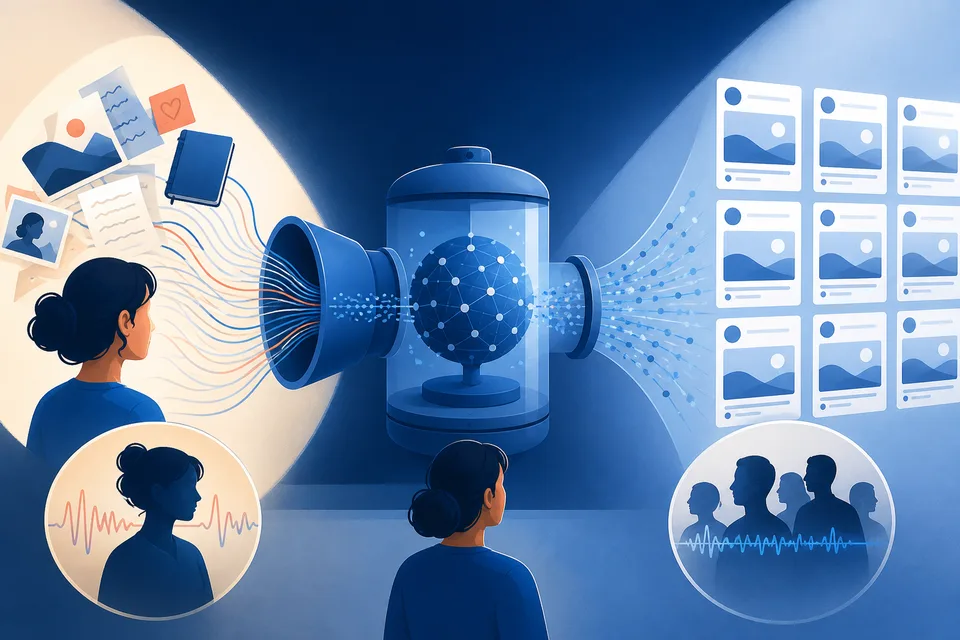
A lot of people start writing LinkedIn posts with ChatGPT or Claude, get a few good results, and then slowly notice the quality sliding. The first posts sound like them. A few weeks later, everything reads generic again, no matter how carefully they prompt. This is not your imagination, and it is not a bad prompt. It is a structural limitation in how general chatbots work.
Every large language model has a context window, the amount of information it can hold in view at once. When you train ChatGPT on your voice by pasting examples, describing your style, and correcting its drafts, all of that lives inside a single conversation's context.
The problem is that the window is finite. As your chat grows, older information falls out of view. The careful voice notes you gave it at the start get pushed out by everything since. So you end up re-explaining who you are, re-pasting examples, and re-teaching your style in a new chat, over and over. Each fresh conversation starts the model back near zero. That is the quiet reason your posts drift back to generic: the model is not holding onto you.
There is a second force underneath this. A language model is trained to predict the most likely next word across enormous amounts of text. Left to its own defaults, it pulls every piece of writing toward the average of everything it has ever seen. On LinkedIn, that average is the exact homogenized style everyone complains about: the same hooks, the same cadence, the same hollow lessons.
Your actual voice is, by definition, not the average. It is specific, a little weird, shaped by your experience. So the moment the model loses the context that anchors it to you, it drifts back to the mean, because the mean is its resting state. Fighting that drift requires constantly, reliably re-supplying context, which a single expanding chat cannot do.
This is the same reason a better prompt cannot fix fake-sounding AI posts. The issue is architectural, not lexical.
People assume the fix is to feed the model more of your writing. That helps briefly, but it runs into the same wall. Everything you feed it competes for space in the same finite window, and as soon as you move to a new task or a new chat, the training evaporates. You are pouring water into a bucket with a hole in the bottom. The harder you work, the more obvious the leak becomes.
The way out is to stop relying on a single ever-growing conversation and instead give the model a fresh, complete context every time it writes, assembled from durable information about you rather than chat history.
That is exactly how SparkVox is built. Each piece of content is generated as its own project with its own clean context window, so it never runs out of room and never carries junk from an unrelated task. Into that window it assembles the things that actually define your voice:
Because this information is stored and re-supplied fresh for every project, the model never loses you and never slides to the mean. The voice profile does not decay as you use it. It gets stronger, because every new transcript adds to it rather than crowding out what came before.
ChatGPT posts get worse over time because a single chat cannot hold your voice indefinitely, and the model's natural gravity is toward average. It is a fine tool for a one-off draft. It is the wrong tool for sounding consistently like yourself, week after week, at scale. For that you need a system designed so context never runs out and your voice compounds instead of leaks.
See the direct comparison in SparkVox vs ChatGPT, or read how to make AI LinkedIn content actually sound like you.
SparkVox
Upload a call, podcast, or interview. SparkVox extracts moments and drafts up to 15 LinkedIn posts in your voice. You review every draft before anything publishes.
Start 14-day Pro trial →Free to sign up. Card required for full access.
No charge until day 15.
Moments found vs posts curated: why SparkVox dropped weak candidates instead of padding to 15 drafts, and what that means for review quality.

My best performing LinkedIn post ever is one I didn't write and tried to delete. Here's why a story pulled from a real conversation beats a link-out video announcement every time.

Not every founder is a writer, and LinkedIn doesn't require you to become one. Here's how SparkVox, ChatGPT, Taplio, and a human ghostwriter compare for founders who want a LinkedIn presence without staring at a blank page.
Your calls and interviews are already the content. SparkVox writes the posts in your voice - upload one recording and see the drafts before you're charged.
Start 14-day Pro trial →Free to sign up. Card required for full access. No charge until day 15.