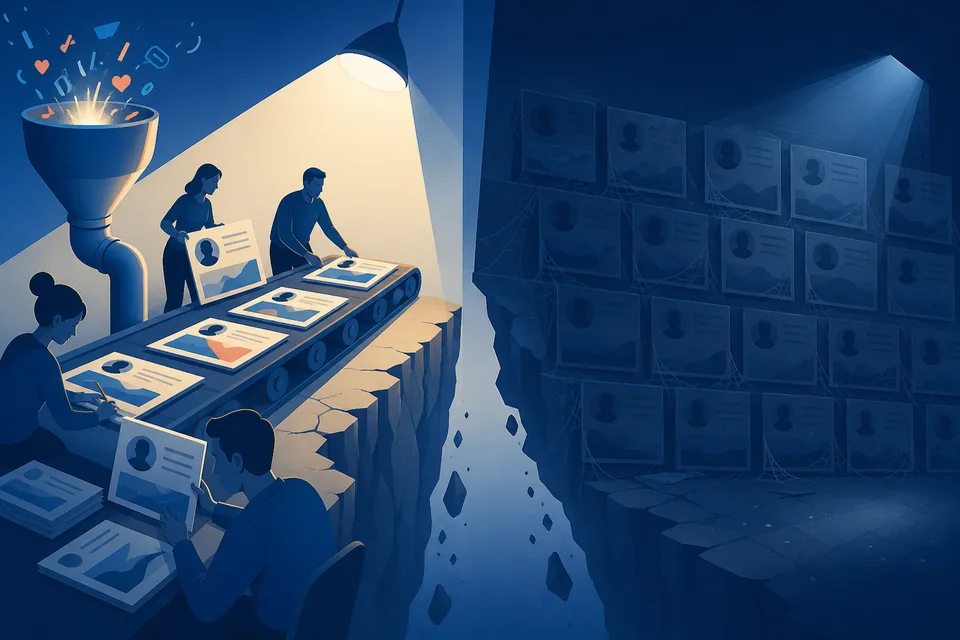
Every agency that adds LinkedIn content to its service list starts the same way: a kickoff call, a content calendar template, real enthusiasm from the client. Three months later, half the accounts have gone quiet. Not because anyone decided to stop - because the system holding it up was never built to last.
This isn't a talent problem. The writers are good. The strategy is usually sound. What breaks is the economics underneath it.
A ghostwriter or VA drafting from a call recording or a client's rough notes takes real time per post - research the topic, match the voice, write a draft, wait for a rewrite cycle. Multiply that across even a dozen client accounts and you're looking at hours per client per week that someone on your team has to absorb, every week, indefinitely.
That's the part most service pricing doesn't account for. LinkedIn gets quoted as a line item early on, when the team is small and everyone has slack in their calendar. It doesn't stay that way. As you add clients, the hours scale linearly with headcount you don't have - so the choice becomes hire more writers on thin margin, or let quality slide.
Ghostwriting gets rejected for a reason that isn't obvious upfront
The failure mode isn't bad writing. It's a draft that sounds like a writer's idea of the client, not the client. Clients and executives can tell immediately, even when they can't articulate why. That triggers a rewrite. The rewrite triggers another approval round. By the time something publishes, it's often stale - and every one of those cycles is unbilled time your team absorbed to get one post live.
Do that enough times and the client stops trusting the process. They start reviewing everything line by line, which is slower for everyone, or they quietly stop engaging and the account goes dormant - which is worse, because now you're billing for a service that visibly isn't happening.
If you're running content for more than one person - a founder and their VP of Sales, three partners at a firm, a roster of client executives - a single shared tone or prompt template can't hold. What reads as authentic for one person reads as generic for the next. Without a way to keep each author's voice genuinely separate, the fastest path is to smooth everyone toward the same safe middle - which is exactly the outcome that gets drafts rejected.
The actual fix isn't more hours - it's a different starting material
The agencies that keep client LinkedIn content alive past month three tend to share one thing: they stopped starting from a blank page and a brief. They start from what the client already said - on a sales call, in a client workshop, on a podcast appearance - and build the post from that. The client's actual language does most of the authenticity work a writer used to have to fake.
That shift changes what "producing LinkedIn content" costs per client - not in effort eliminated, but in effort redirected from drafting to reviewing. We cover exactly how that works, and what it does to the per-client math, in how agencies scale client LinkedIn content without adding writers.
What this looks like at three, ten, and thirty clients
At three clients, the cracks aren't visible yet - a small team can absorb the hours, and the founder is probably still doing some of the drafting personally. At ten clients, the math starts to bite: someone's working nights to keep up, or quality has quietly started sliding on the accounts that get less attention. At thirty clients, the agency has either found a way to break the linear relationship between client count and hours, or it's stopped growing - not from lack of demand, but because the current model genuinely cannot take on client thirty-one without either hiring at a pace the margin can't support or letting the newest accounts get the worst service.
Most agencies discover this ceiling exists the hard way, around client fifteen or twenty, rather than planning for it from client one.
That shift changes what "producing LinkedIn content" costs per client - not in effort eliminated, but in effort redirected from drafting to reviewing. We cover exactly how that works, and what it does to the per-client math, in how agencies scale client LinkedIn content without adding writers, and the real cost comparison against hiring in agency pricing vs hiring a junior ghostwriter: the real break-even.
If you're already running this at real client volume, see how SparkVox handles per-author voice profiles at scale.