

ProductContent Strategy
Strategy Behind This Post: Why SparkVox Shows Its Work
Transcript quote, funnel job, distinctiveness score, column brief, and learned voice rules - what the Strategy behind this post drawer shows before you approve.
My best performing LinkedIn post ever is one I didn't write and tried to delete. Here's why a story pulled from a real conversation beats a link-out video announcement every time.
 Sean Weisbrot- Founder, SparkVox
My best performing LinkedIn post ever is one I didn't write and tried to delete.
It was a rough draft about AI and accounting - a half-formed thought pulled from a call, not a polished take I'd planned to publish. I almost deleted it before posting because it felt too unfinished to put my name on. I posted it anyway. It went on to get 21,000 impressions, several times anything else I'd published that month, and led to a connection that turned into real business. Nothing about it was optimized. It was just true, specific, and slightly uncomfortable to say out loud.
That post taught me something that changes how I think about every piece of content since: polish doesn't spread. Specificity does.
If you host a podcast or publish long-form video, there's a familiar pattern: the episode drops, and the LinkedIn post is a link-out. "New episode is live - link in comments." It reads as an ask, not a story. LinkedIn's own ranking model throttles posts that route attention off-platform, and readers can feel the ask even before the algorithm penalizes it - a link-out post is asking them to leave LinkedIn to go find out why they should care, before you've given them a reason to care at all.
The result is a post that gets a fraction of the reach of the conversation it's promoting, even when the conversation itself was genuinely good.
Instead of announcing that a conversation happened, pull the moment out of it. Not a summary - a specific story, a contrarian line, a beat where something surprising got said. The reader doesn't need to leave LinkedIn to get value; the value is already in the post. If the story lands, curiosity about the fuller conversation follows naturally instead of being demanded up front.
This is the difference between "I recorded a great conversation about X" and actually telling the moment from that conversation that made you want to record it in the first place. One is marketing copy for content you haven't shown me yet. The other is the content.
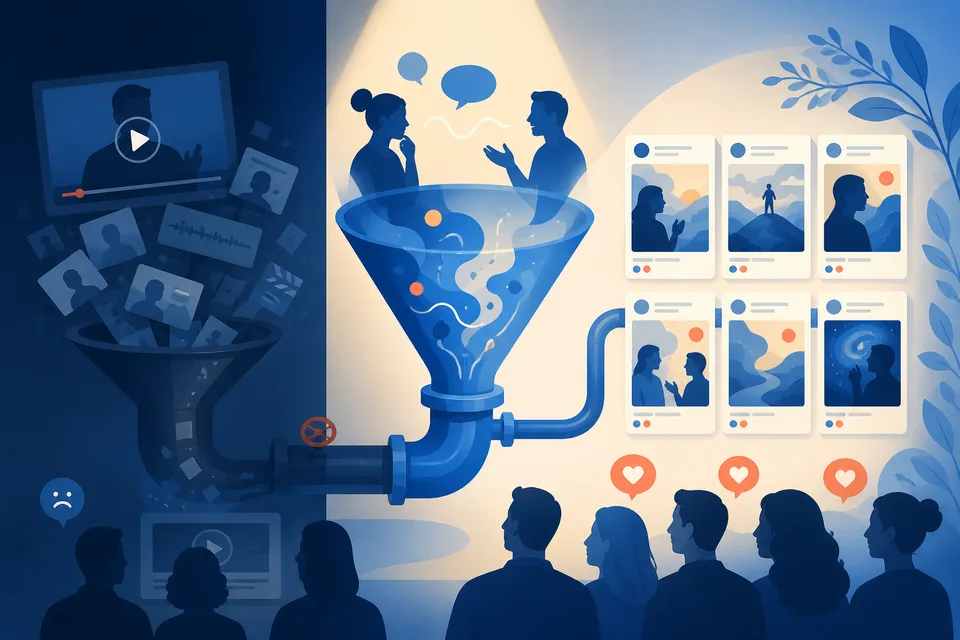
The order matters more than most people think:
Each stage does a different job: earn attention, add proof, then convert the people who are already leaning in. Reversing the order - link first, story never - skips straight to the ask and gets the throttled result you'd expect.
The post I almost deleted worked precisely because it wasn't run through the usual filter. It didn't have a tidy conclusion. It admitted uncertainty. It sounded like someone thinking out loud on a call, because that's exactly what it was. Most people's instinct is to smooth that out before publishing - to make it sound more finished, more confident, more like "content." That instinct is usually wrong.
A polished announcement blends in with every other polished announcement in the feed. A half-formed, honest thought stands out because it reads like a person, not a press release.
If you already record calls, podcasts, or interviews, you don't need a new content strategy - you need to stop skipping the step where you pull a real moment out of the conversation and let it stand on its own before you ever mention that a longer recording exists. This is the same reason recording-first repurposing outperforms writing from a blank prompt: the material is already specific, because it came from an actual conversation instead of an attempt to sound like one.
Polish doesn't spread. The slightly uncomfortable idea you almost didn't say is what gets people to stop scrolling.
For more on why recordings outperform prompts as source material, see your recording is not "past output", and for the mechanics of pulling posts out of a conversation, see how to repurpose content for LinkedIn.
SparkVox
Upload a call, podcast, or interview. SparkVox extracts moments and drafts up to 15 LinkedIn posts in your voice. You review every draft before anything publishes.
Free to sign up. Card required for full access.
No charge until day 15.
Transcript quote, funnel job, distinctiveness score, column brief, and learned voice rules - what the Strategy behind this post drawer shows before you approve.

Moments found vs posts curated: why SparkVox dropped weak candidates instead of padding to 15 drafts, and what that means for review quality.

Advice written cold for LinkedIn often comes out softer than it did in the actual client conversation. Here's why the room and the feed produce different versions, and what that costs.
Your calls and interviews are already the content. SparkVox writes the posts in your voice - upload one recording and see the drafts before you're charged.
Free to sign up. Card required for full access.
No charge until day 15.