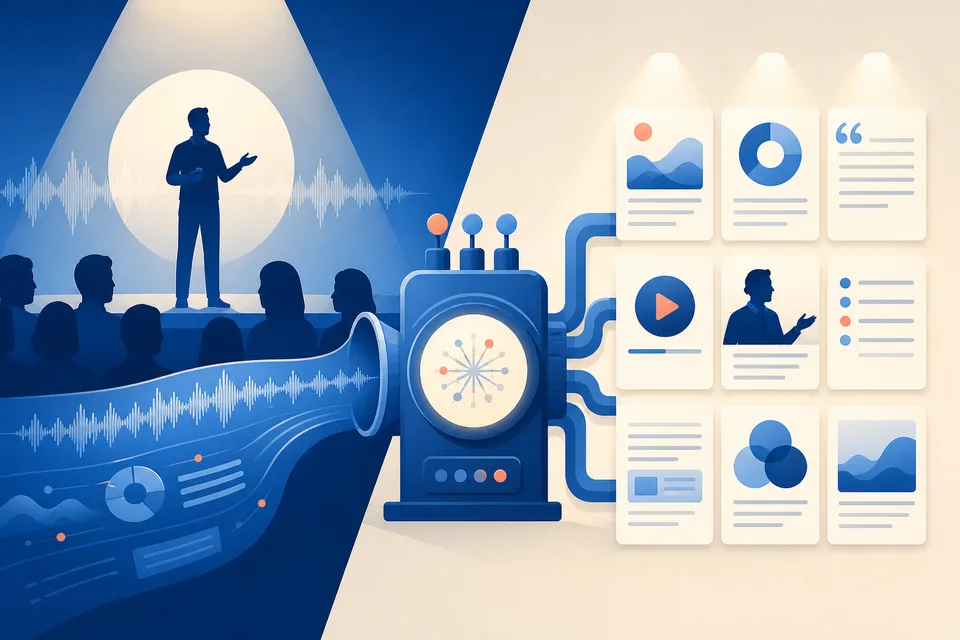
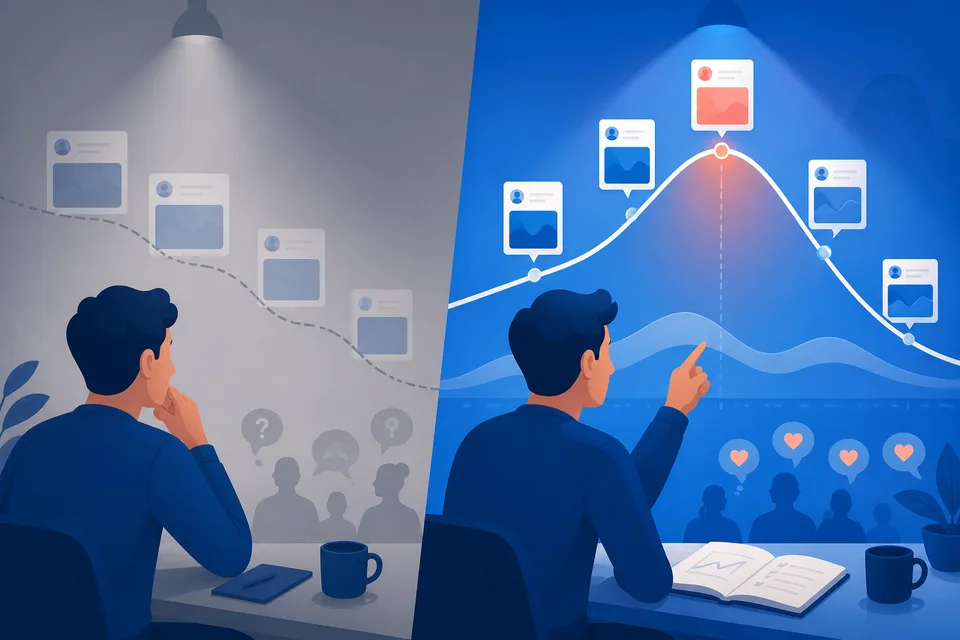
A consultant recording a solo keynote or training has a different repurposing need than one on a two-way client call - there's no second voice to separate out, and no client confidentiality to strip away.
Why Advisor perspective is built for a different problem
Advisor perspective exists specifically to isolate a consultant's own contributions from a multi-speaker call and generalize away client-specific detail. That's real, useful work - but it's solving a problem a solo recording doesn't have.
What Expert perspective does instead
For a recording where the consultant is the only speaker - a keynote, a solo workshop, a training session delivered without back-and-forth - Expert perspective works directly from the full recording without a speaker-separation step, since there's nothing to separate. The extraction focuses purely on identifying distinct frameworks and moments worth their own post.
Choosing the right one matters less for correctness (both produce usable drafts either way) and more for efficiency - Expert perspective skips a step that a solo recording doesn't need.
What happens if the wrong perspective gets chosen
Using Advisor perspective on a genuinely solo recording doesn't produce wrong output - there's no second speaker to accidentally mix in, so the safety concern doesn't apply. It just runs an extra classification step the recording didn't need, which is a minor efficiency cost rather than an accuracy risk. The reverse case - using Expert perspective on a real multi-speaker call - is the one that actually matters, since that risks blending another person's words into the consultant's drafts without the explicit separation step.
A borderline case worth naming
A "solo" training that includes brief audience Q&A isn't purely solo anymore - if participant questions get picked up in the recording, that's technically multi-speaker, even if one person is talking for 90% of the runtime. For sessions like this, Advisor perspective's speaker separation is the safer default, since it explicitly filters out anything that isn't the consultant's own voice, audience questions included.
A simple rule of thumb
When genuinely unsure which to pick, defaulting to Advisor perspective is the safer choice - the small efficiency cost on a truly solo recording is a much smaller downside than accidentally blending a second voice into a multi-speaker one. Expert perspective is worth reaching for specifically once it's clear the recording is solo throughout.
See both perspectives in the full workflow on SparkVox for consultants and coaches, how Advisor perspective handles client calls specifically in how to turn every client call into a reusable framework post, and how a keynote specifically benefits from Expert perspective in turning a keynote recording into a month of LinkedIn authority content.