

CompareStrategy
SparkVox vs Hiring a Ghostwriter Who Wasn't in the Room
A ghostwriter works from a briefing call or a summary - secondhand material reconstructed after the fact. Here's what that misses compared to working from the actual transcript.
A bilingual ghostwriter is more capable than a plain translation service. Here's what a good one does well, and where the model strains at regular posting volume.
 Sean Weisbrot- Founder, SparkVox

A bilingual ghostwriter - someone who reads the founder's native language and writes fluent English - is a real alternative for non-native English content, and a more capable one than a plain translation service. The comparison worth making is what a ghostwriter can and can't scale.
A skilled bilingual writer reads for meaning the same way a good recording-first workflow does, and can genuinely capture nuance a machine process might miss on a hard case. For occasional, high-stakes content, that judgment is worth paying for directly.
A ghostwriter needs new material each time - a call, a briefing, something to work from - and producing multiple posts a week means either a lot of source material flowing to them constantly or the founder spending real time briefing them regularly. That's the same calendar-cost problem any ghostwriter relationship runs into, just with an added bilingual skill requirement that narrows who's qualified to do it well.
A workflow that reads recordings directly, without needing a person to relay the material first, removes that bottleneck - not by replacing judgment, but by removing the step where material has to pass through a person before it can become a draft.
Finding someone fluent in a specific language pair and a strong English writer is already a narrower search than finding a good English-only ghostwriter. Finding someone who's also available, affordable, and willing to work at the cadence a regular LinkedIn habit requires narrows it further. That scarcity is part of what drives up the cost and the difficulty of finding a good long-term fit for this specific arrangement.
For founders who value having a bilingual person's judgment on hand, the strongest setup isn't necessarily choosing one over the other - it's a bilingual writer doing a lighter editorial pass on drafts that already came from reading the recording for meaning, rather than generating every post from a fresh briefing. That keeps their judgment in the loop where it matters most while removing the recurring briefing cost.
The honest question is how often genuinely hard, nuance-heavy content actually comes up versus routine posts that don't need a specialist's judgment - most founders find the split is lopsided toward the routine, which is exactly where a recording-first workflow alone tends to cover the majority of the need.
See the recording-first approach in how to record in your own language and publish polished English LinkedIn posts, and the same comparison against a purely automated translate-then-polish workflow in SparkVox vs Google Translate + ChatGPT for your own LinkedIn voice, or the full setup on SparkVox for non-native English speakers.
SparkVox
Upload a call, podcast, or interview. SparkVox extracts moments and drafts up to 15 LinkedIn posts in your voice. You review every draft before anything publishes.
Free to sign up. Card required for full access.
No charge until day 15.
A ghostwriter works from a briefing call or a summary - secondhand material reconstructed after the fact. Here's what that misses compared to working from the actual transcript.

Why password vaults and screen-share OAuth do not scale for agency LinkedIn — and how SparkVox connection links keep clients in control of their credentials.
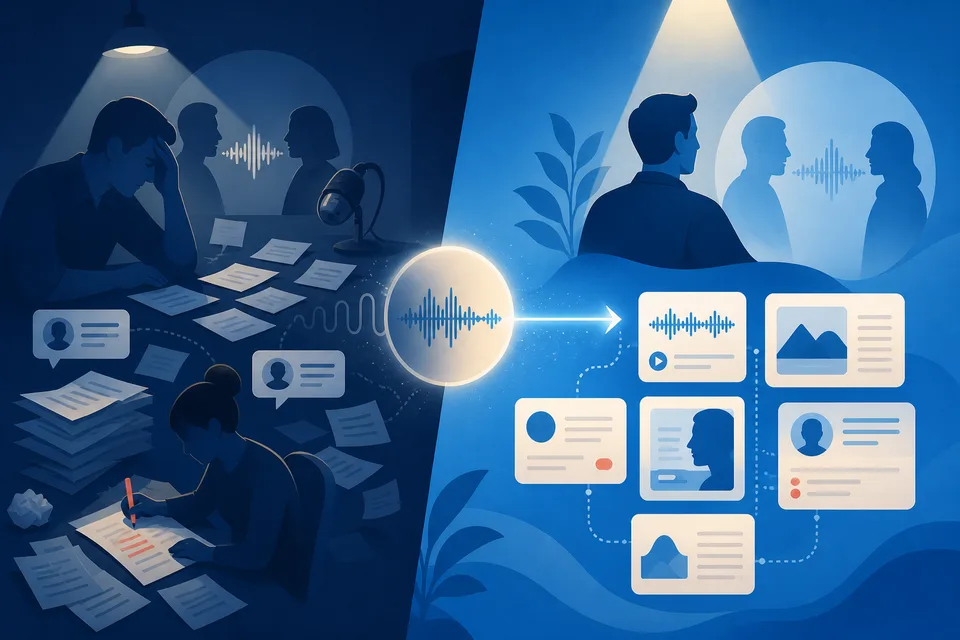
Handing repurposing to an assistant gets the task off your plate in theory. Here's what an assistant still needs from you, and where delegation to an assistant actually works best.
Your calls and interviews are already the content. SparkVox writes the posts in your voice - upload one recording and see the drafts before you're charged.
Free to sign up. Card required for full access.
No charge until day 15.