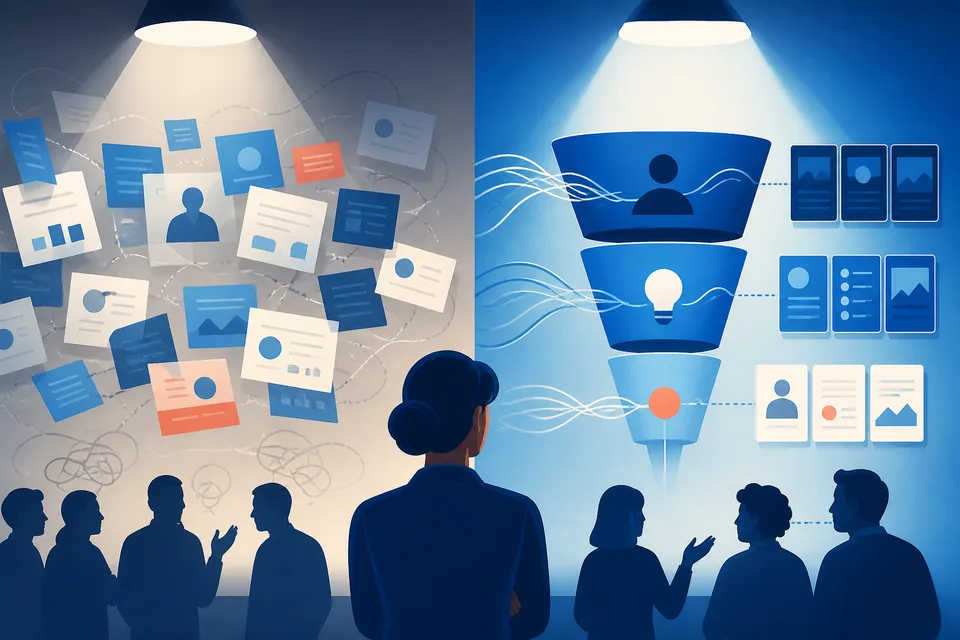
A prospect finds you, checks your LinkedIn before booking a call, and sees a feed that hasn't moved in six weeks. Nothing on it says what you actually know - just an old headshot and a bio that reads like every other consultant's. They book the call anyway, maybe, or they book with the person whose feed made the decision for them already.
That's the paradox: you sell expertise for a living, deliver it constantly - on calls, in workshops, in advisory sessions - and almost none of it ever reaches the one channel where a prospect actually forms an opinion of you before they've spoken to you.
The insight isn't missing. The write-up is.
This week, you probably explained a framework on a client call that made someone say "that changes everything." You probably didn't write it down anywhere a stranger could find it. Not because it wasn't good - because writing it up requires stepping outside the delivery mode you're actually good at (explaining, live, in response to a real problem) and into a different mode (writing, cold, from a blank page) that most consultants find genuinely harder and consistently deprioritize.
Multiply that by every call this month, and the gap isn't a content problem. It's dozens of pieces of proof-of-expertise that existed for forty-five minutes and then disappeared.
Why "I'll write it up later" doesn't happen
Later competes with the next client call, the next proposal, the actual paid work. Writing up a framework from memory a week after you delivered it is slower and worse than writing it the day of - the sharp phrasing you used live is already fading. So it gets pushed further, and eventually dropped, and the feed stays quiet while the expertise keeps happening in rooms nobody outside the client sees.
Generic AI posts make the gap worse, not better
The instinct to fix a quiet feed with a prompt - "write me a LinkedIn post about [topic]" - produces something that sounds like a consultant, generically, instead of sounding like you specifically. Prospects who are evaluating whether to trust you with a real problem can tell the difference between a templated post and the exact framing you'd use in the room. A generic post doesn't fill the gap; it just fills the space where a real one should be.
The actual fix starts from where the expertise already lives - the recording of the call itself. We cover exactly how that works in how to turn every client call into a reusable framework post.
What the paradox costs in a specific, countable way
A consultant running four client calls a week, each one containing at least one framework or insight worth sharing, generates roughly 200 unwritten posts a year - not a vague sense of "missed content," but a specific, countable number of moments that existed and then didn't. Most consultants underestimate this because it never feels like 200 losses; it feels like 200 ordinary Tuesdays where nothing seemed worth stopping to write about in the moment.
The prospects who would have found those posts compelling never saw them, obviously - but so did the referral partners who might have shared a sharp post with their own network, and the past clients who might have been reminded you exist by seeing your name in their feed. The cost isn't just "fewer posts." It's fewer of the small, ongoing nudges that keep a consultant top of mind between projects.
Why this hits differently than a founder's version of the same problem
A founder's LinkedIn silence reads as "busy building." A consultant's LinkedIn silence reads differently, because the entire pitch is "hire me for my judgment" - and a prospect's first data point on that judgment, before any call happens, is whatever they can find publicly. For a consultant specifically, an empty feed isn't neutral; it's the absence of the one piece of evidence a prospect could have checked for free.
The actual fix starts from where the expertise already lives - the recording of the call itself. We cover exactly how that works in how to turn every client call into a reusable framework post, and how it compares to filling in a swipe file instead in SparkVox vs a template library for consultant LinkedIn content.
See the full workflow on SparkVox for consultants and coaches.