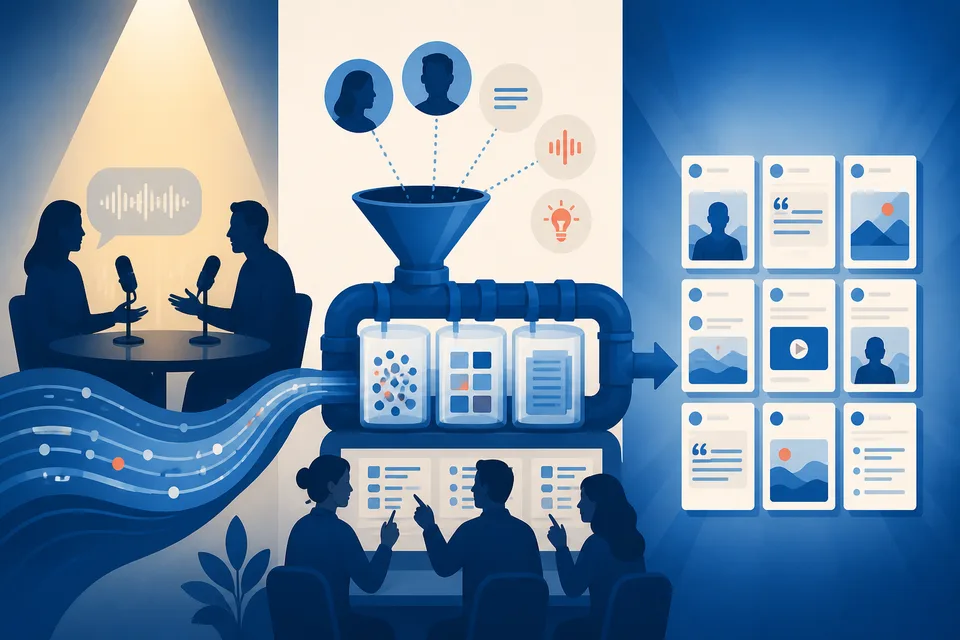
The episode is live. The client is happy. Then the standard next step happens: someone writes "excited to have joined [show] to talk about [topic] - link in comments," it gets a polite handful of likes, and the placement's LinkedIn life ends there.
Everything the client actually said in the interview - the framework, the contrarian answer, the story that made the host lean in - never left the recording. That's the part worth fixing, and it doesn't require a new brief or a new writer. It requires using the interview itself as the source material.
The recording already has the content in it
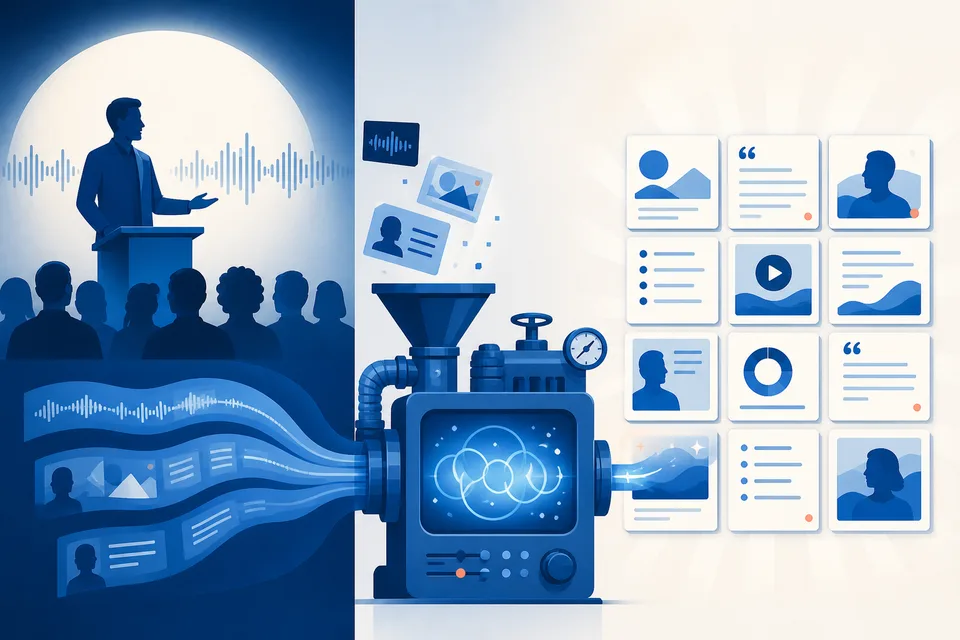
A 30-45 minute guest appearance contains far more than one post's worth of material - the client answered several distinct questions, told at least one story worth retelling on its own, and probably said something quotable enough that the host will remember it. Extracted properly, that's easily two weeks of posts, not one.
The catch with a normal repurposing workflow is that an interview has two speakers, and only one of them is your client. Posting the host's questions as if the client said them breaks the entire premise.
Speaker selection solves the two-voice problem
Upload the episode - file, YouTube link, or transcript - to the client's account using Guest perspective, and the diarization step shows sample lines from each speaker before anything drafts. Pick the client's voice, and only their utterances feed the drafts - not the host's banter or questions. The output reads as the client speaking, because it's built only from what the client actually said.
Timing the drafts to the publicity window
A placement's attention has a shelf life - the first few days after it airs, while it's still being shared by the host and their audience, are worth more than week three. Two weeks of drafts, ready to review at once, means you can stack the client's posts across that live window and tag the host on each one - extending the placement's reach past the day it aired instead of it fading into the show's back catalog.
What stays separate per client
Every client needs their own account and their own voice profile - one PR firm running content for a dozen clients cannot use one shared tone across all of them. Each account's profile compounds independently from that client's transcripts, approved posts, and edits, so the fifth placement for a given client needs less editing than the first, and no client's phrasing bleeds into another's.
Load a Sparky Brief once per client - their positioning, audience, and story - and every future placement drafts with that context already loaded, so a client's tenth appearance sounds as sharp as their first.
What "only their lines" actually catches
Speaker selection isn't a nice-to-have on interview repurposing - it's the difference between usable and unusable output. Without it, a host's setup question like "so tell me about how you got into this" can end up phrased as if the client said it, or the client's answer gets fused with the host's follow-up into one garbled sentence. With speaker selection, the drafting step only ever sees the client's own turns in the transcript - the host's questions exist only as context for what the client was responding to, never as source material for a post.
This matters more on interview shows than on solo appearances, since a co-host or a panel format means three or four voices could plausibly get mixed together without an explicit selection step.
What one client's onboarding looks like in practice
A new client's first placement: their account gets set up, their Sparky Brief is loaded with positioning and background once, and the first episode gets uploaded under Guest perspective. That first batch of drafts needs real review - the voice profile only has one recording to learn from. By the third or fourth placement, review time drops noticeably, since the profile has enough real examples of the client's phrasing to guess correctly more often - which is when a PR team actually starts feeling the time savings on that account.
See the full per-client setup, pricing, and reporting on SparkVox for PR firms, the case for why this needs to happen at all in why a media placement isn't a LinkedIn strategy, and how fast a real turnaround looks in how fast can a team turn around content after a placement goes live.