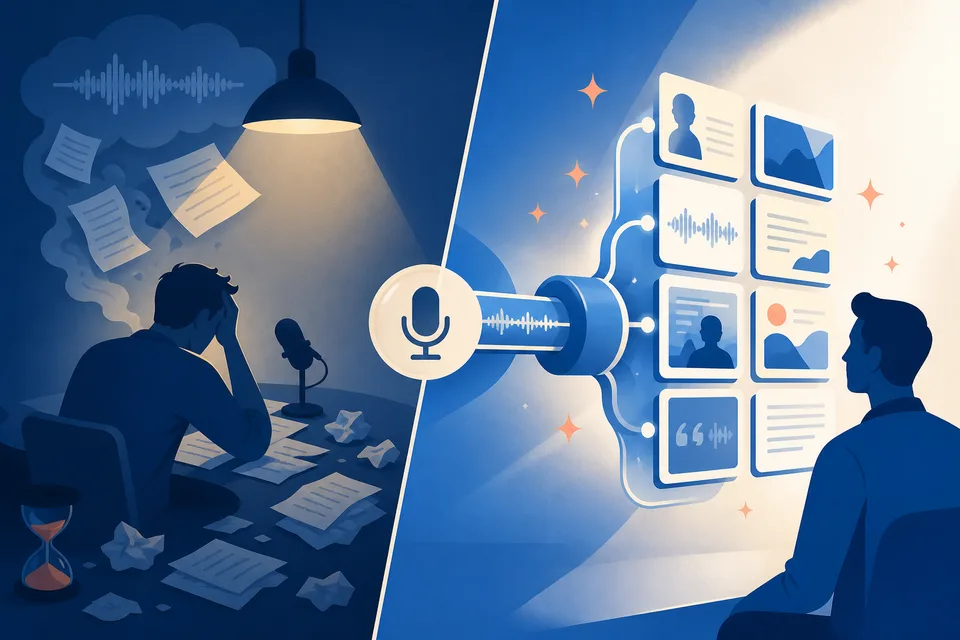
The realistic alternative to a repurposing tool isn't a ghostwriter - it's what most guests actually do, which is nothing, or occasionally listening back to an episode and writing one post from memory. Worth comparing honestly, since "doing it yourself" is free and the tool isn't.
What doing it yourself actually costs
Listening back to a 30-45 minute episode to pull out the good moments takes close to the length of the episode itself, done properly. Writing one post from that takes another stretch of focused time. Doing that for even half your guest appearances means finding an hour-plus per episode that has to come from somewhere else in the week - which is exactly why most guests, honestly, do this for zero episodes rather than some.
What the DIY version tends to produce even when it happens
When guests do write it up themselves, it's usually one post - the most memorable moment, written from memory a few days after the episode aired, once the phrasing has already faded a little. That's a real post, but it's one post from a conversation that likely contained five or six distinct moments worth their own.
Where the trade-off actually sits
For someone who guests on one podcast a year, the DIY version is probably fine - the setup cost of a tool isn't worth it for that volume. The gap opens up for guests appearing regularly, where the DIY hour-plus per episode either doesn't happen consistently or crowds out other work every time it does.
The annual math for a regular guest
Someone guesting on a podcast twice a month is looking at roughly 24 appearances a year. At an hour-plus of DIY effort each, done consistently, that's 25-30 hours annually just on repurposing - on top of the actual appearances. Realistically, most people at that frequency don't sustain the DIY version consistently; it happens for the appearances that felt especially good and gets skipped for the rest, which means most of those 24 appearances produce nothing at all rather than one solid post each.
The honest comparison isn't "DIY time versus tool cost" in the abstract - it's "DIY time that mostly doesn't happen versus a review habit that actually does," since the real alternative to using a tool usually isn't a diligent hour per episode, it's inconsistency.
What doesn't change either way
Neither approach removes the judgment call of whether a draft is actually good enough to publish - that review step exists regardless of whether the first draft came from your own memory or from processed transcript. The difference is entirely in how much work happens before you get to that judgment call, not in whether judgment is still required.
See the full extraction workflow on SparkVox for expert guests, and how many posts a real appearance tends to produce in how many LinkedIn posts should one guest appearance actually produce.